
Creating jewelry with crystal beads isn’t just a creative hobby—it’s a gateway into the thriving world of fashion accessories manufacturing. For those exploring B2B opportunities, such as jewelry wholesalers, retail brand owners, and private label buyers, understanding how crystal-bead jewelry is crafted builds a solid foundation for future sourcing and production decisions. Whether you’re launching your first product line or planning OEM/ODM collaboration with a custom jewelry supplier, starting with crystal beads helps you grasp craftsmanship, design balance, and supply chain fundamentals.
To start making crystal-bead jewelry, begin with basic tools (pliers, cutters, bead board, needles) and affordable materials for practice. Learn essential assembly techniques like stringing, knotting, and crimping before sourcing premium crystals such as Czech glass or Swarovski alternatives. Choose reliable wholesale suppliers offering both loose crystal beads and matching findings to ensure design cohesion. For production planning, estimate costs and lead time based on bead type, labor skills, and MOQ requirements. This foundation supports efficient onboarding with an OEM jewelry manufacturer when scaling to bulk production.
From a manufacturing perspective, the crystal-bead jewelry segment reflects strong global demand across gift, fashion, and semi-luxury markets. Understanding bead quality, plating options, and hardware types allows buyers to make strategic sourcing decisions. In this guide, I’ll walk you through how to begin creating crystal-bead jewelry, what basic skills you need, how to match findings to your bead designs, where to find reliable wholesale suppliers, and how to calculate production time and cost for your first collection.
What Basic Skills Do I Need Before Sourcing Crystal Bead Materials?
Before sourcing materials or placing OEM orders, it’s crucial to learn fundamental jewelry-making techniques. I always tell new brand owners—start simple before integrating advanced assembly or design patterns. As a professional jewelry manufacturer working extensively with crystals, I’ve seen how technical understanding translates directly to more efficient sourcing and clearer product specifications.
Essential Beginner Techniques
- Stringing: Learn how to thread beads evenly on elastic, nylon, or beading wire. This simple technique applies to bracelets, necklaces, and anklets.
- Crimping: Practice securing wire ends with crimp beads for a clean, professional finish.
- Wire Wrapping: Used to create pendants or charms with crystal points.
- Knotting: Ideal for pieces with silk thread or pearls.
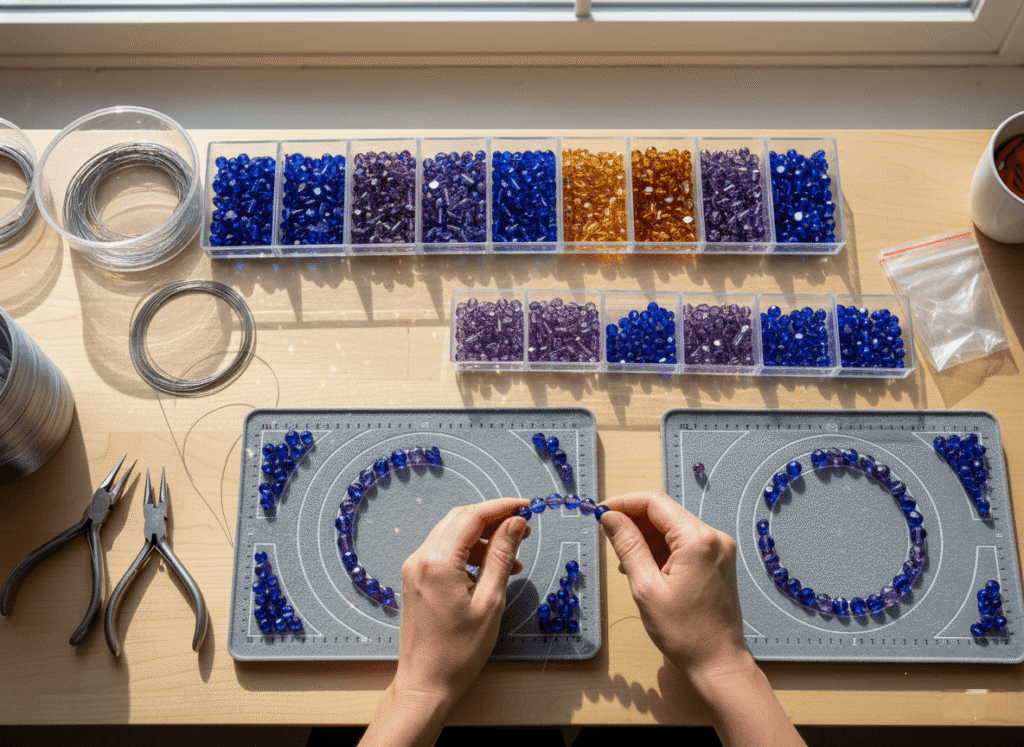
- Color Layout & Design Planning: Using a bead board helps distribute bead colors, sizes, and spacing evenly, improving the balance of your piece.
Basic Toolset Setup
A proper toolkit is your first asset as a jewelry creator:
| Tool Type | Function | Cost Range (USD) | Recommended for |
|---|---|---|---|
| Round-nose pliers | Wire loops & wrapping | $7–$15 | Earrings, pendants |
| Flat-nose pliers | Holding & tightening | $6–$12 | Clasps, jump rings |
| Wire cutters | Cutting wire & chain | $8–$20 | All designs |
| Beading needle | Stringing thread-based designs | $2–$8 | Fine threads |
| Bead board | Layout planning | $5–$10 | Bracelets, necklaces |
Material Familiarity: Crystals vs Glass vs Resin
Understanding bead material composition is equally important. Crystal beads are often made from high-lead glass, cut precisely for brilliance. Czech and Austrian crystals tend to have sharper facets and richer colors compared to resin or acrylic beads. This knowledge helps assess both cost and product appeal when negotiating with suppliers.
How Can I Choose the Right Findings and Components to Match My Crystal Bead Designs?
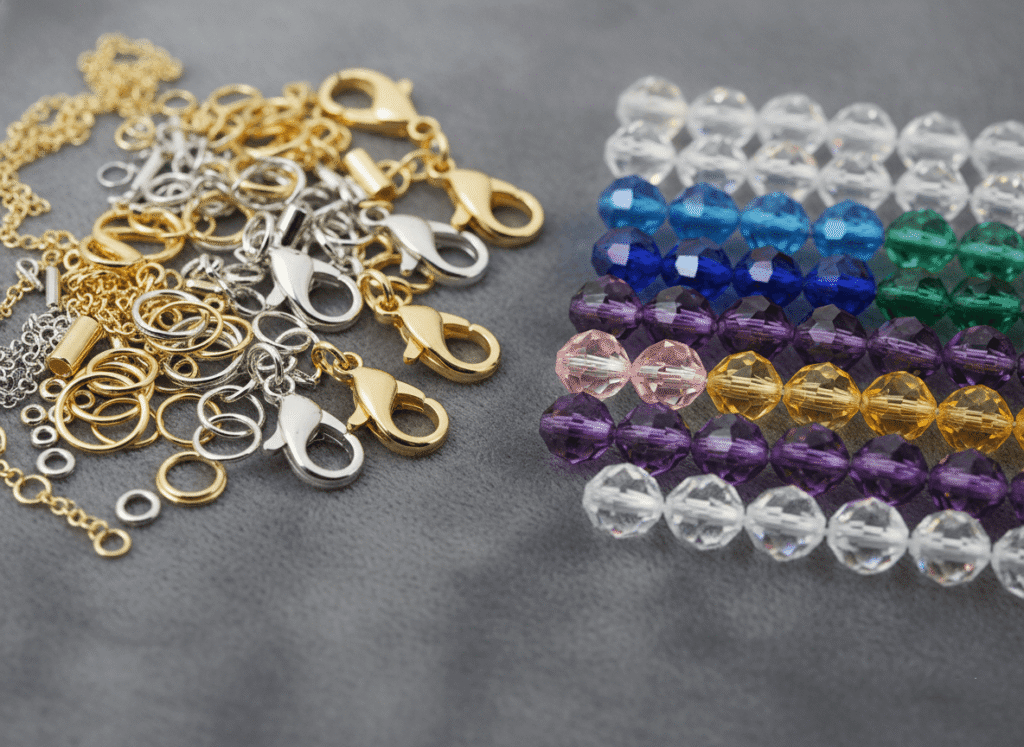
Findings—clasps, jump rings, crimp covers, and connectors—determine your jewelry’s durability and finish quality. When sourcing wholesale jewelry components, alignment between bead aesthetics and findings is vital for cohesive brand presentation.
Choosing Findings: Aesthetic and Technical Match
Here’s how I evaluate findings for crystal-bead jewelry during OEM development:
- Material Compatibility: Stainless steel findings offer strong durability and anti-tarnish properties. Brass is ideal for plating customization. Alloy findings are cost-efficient but need extra plating protection.
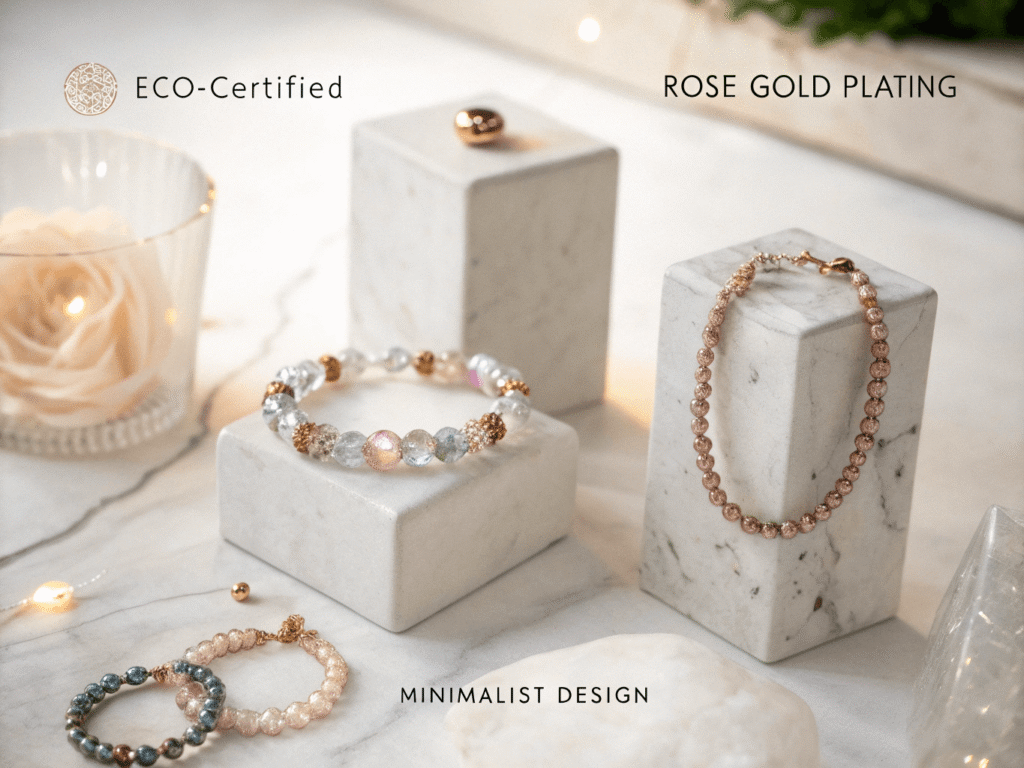
- Color Coordination: Match bead tone and metal finish—silver findings with blue or cool-toned beads, gold for warm shades, and rose gold for pastel collections.
- Design Purpose: Heavy crystal beads require stronger findings (thicker jump rings, reinforced clasps). Lightweight crystal accent pieces can use smaller components for a delicate look.
Common Findings Overview
| Finding Type | Material Options | Function | Notes |
|---|---|---|---|
| Crimp beads | Brass, copper | Secure wire ends | Use plated variants for corrosion resistance |
| Jump rings | Stainless steel, alloy | Attach components | Always close securely for QC |
| Clasps | Zinc alloy, stainless steel | Closure element | Choose lobster clasps for bracelets |
| Head pins | Brass, stainless | Secure bead dangles | For earring manufacturing |
| Extension chains | Alloy | Adjustable length | Adds flexibility to sizing |
Subheading: OEM vs ODM Component Selection
In B2B settings, component selection often defines the success of bulk orders.
- OEM (Custom Design): You specify materials, plating color, and hardness level.
- ODM (White Label): Use existing supplier components that match your design guidelines.
To reduce MOQ risks, I recommend sourcing standard findings first before customizing plating or color tones.
Where Can I Find Reliable Wholesale Suppliers for Crystal Beads and Fittings?
Finding trustworthy crystal bead and findings suppliers is the most critical step toward scaling production. I’ve personally collaborated with factories in China, Thailand, and the Czech Republic that specialize in crystal components for both fashion and premium markets.
Supplier Categories
- Wholesale Crystal Bead Manufacturers
Offer loose beads in round, bicone, faceted, and teardrop shapes with color consistency and sizing precision.
- Keywords: fashion jewelry wholesale China, crystal bead manufacturer, custom jewelry supplier.
- Jewelry Component Factories
Produce findings, chains, and clasps in stainless steel or brass base material—often providing OEM plating customization. - Integrated Jewelry Production Partners
Handle full assembly (design + findings + packaging). Ideal for private label brands needing turnkey services.
How to Evaluate a Supplier
| Evaluation Criteria | Recommended Standard | Notes |
|---|---|---|
| MOQ | 100–500 pcs per design | Flexible for start-up brands |
| Material Verification | SGS or REACH certified | Ensures eco-compliance |
| Plating Thickness | ≥ 0.3µm for gold/silver | Improves anti-tarnish |
| Sample Policy | Free or partial refund | Reduces inspection cost |
| Lead Time | 20–35 days per design | Account for QC and plating process |
Supply Chain and Sourcing Tips
- Work with suppliers based near material hubs (e.g., Yiwu or Guangzhou for crystal beads).
- Always request plating test samples and metal composition reports.
- For large orders, perform random QC checks or use third-party inspection agents.
- Negotiate bulk discounts or shared shipment consolidation to lower per-unit cost.
How Do I Estimate Production Time and Cost for My First Crystal Bead Jewelry Collection?
Production planning is where creativity meets supply chain discipline. Whether you’re sourcing from a custom jewelry supplier or manufacturing in-house, estimating time and costs accurately helps maintain profitability.
Cost Estimation Breakdown
Consider five major cost components:
| Cost Component | Description | Typical Range (USD Per Unit) |
|---|---|---|
| Bead Material | Crystal, glass, or acrylic | $0.05–$2.00 |
| Findings & Hardware | Clasps, jump rings, chains | $0.10–$0.80 |
| Labor Cost | Assembly & finishing | $0.30–$1.50 |
| Plating/Finishing | Gold, silver, rhodium layers | $0.15–$0.70 |
| Packaging & QC | Branded boxes or cards | $0.10–$0.50 |
Total unit cost typically ranges $1–$5 per piece, depending on complexity and production region. Wholesale pricing margins often fall between 2.5×–3× manufacturing cost.
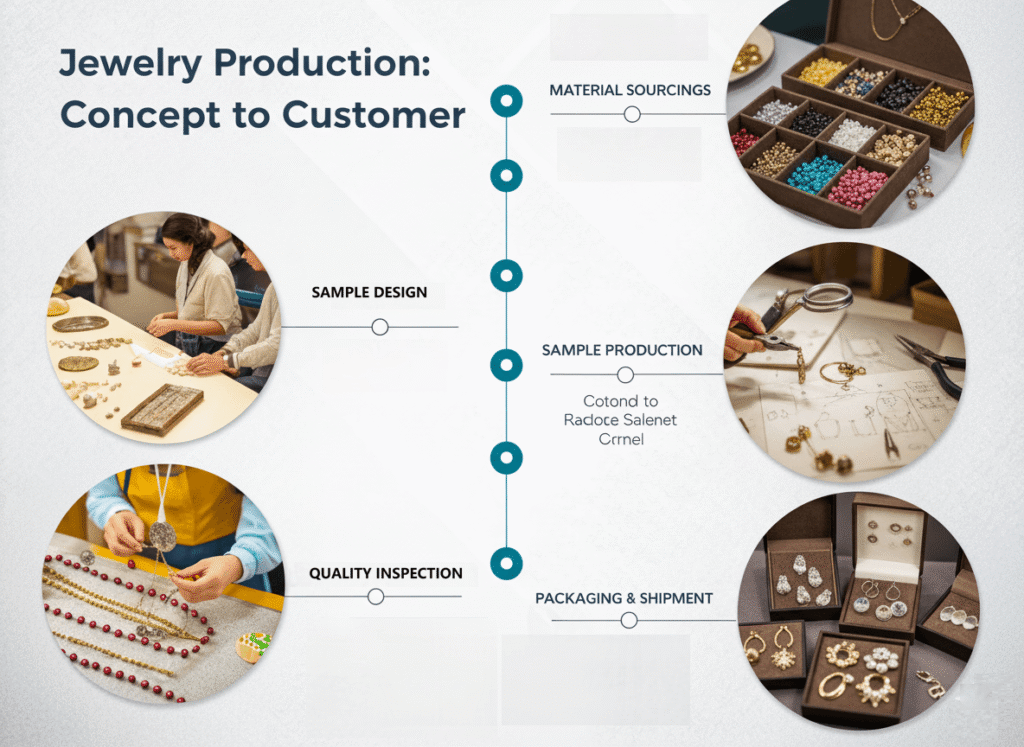
Production Time Estimation Model
| Stage | Duration | Description |
|---|---|---|
| Material sourcing | 5–10 days | Beads and findings procurement |
| Sample design | 7–12 days | Layout testing and approval |
| Mass production | 15–25 days | Assembly and plating |
| QC inspection & packing | 5–10 days | Random checks & box sealing |
Total Estimated Lead Time: 30–45 days for first batch.
Always buffer 7–10 days for plating or shipping delays.
Scaling from Handmade to B2B Manufacturing
If you’re transitioning from personal crafting to wholesale production:
- Document your design steps and record exact bead counts and spacing.
- Use CAD or vector design templates for repeating bead patterns.
- Partner with an OEM jewelry factory offering flexible MOQ.
For instance, when we produce crystal-bead bracelets at scale, bead count per strand is pre-measured by machine, findings are batch-crimped for uniformity, and QC teams conduct random tensile tests to ensure consistent product strength.
Advanced Section: Material & Plating Comparison for B2B Reference
When scaling crystal jewelry, plating quality and base material choice strongly influence retail longevity.
| Base Material | Best Plating Match | Durability | Recommended Use |
|---|---|---|---|
| Stainless Steel | 18K Gold / PVD | High | Everyday wear collections |
| Brass | Rhodium / Rose Gold | Moderate | Mid-range fashion jewelry |
| Zinc Alloy | Electroplated Gold/Silver | Low-Medium | Trend-focused lower-cost lines |
Plating Quality Standards
The plating should reach at least 0.3µm for gold and 0.5µm for silver finishes. Stronger PVD coatings extend color life beyond 12 months under normal wear. Always verify plating thickness using supplier test reports or XRF inspection.
Trend Insight: Global Crystal Jewelry Market Behavior
Crystal jewelry sells strongly in seasonal and gifting markets.
Key 2024–2025 sourcing trends include:
- Rising preference for eco-certified crystals and lead-free glass alternatives.
- Colorful minimalist designs leveraging aurora or pastel crystal tones.
- Demand for mix-material designs combining crystals with stainless steel or resin accents.
- Flexible MOQ from Chinese suppliers encourages smaller brand experiments.
Strategically, crystal jewelry operates between fine gemstone jewelry and costume jewelry. Its versatility allows fast trend adaptation while maintaining perceived luxury—making it ideal for both mass-production and boutique brand development.
Conclusion: Step Forward with Confidence in Crystal-Bead Jewelry Making
Starting crystal-bead jewelry creation builds not only your craftsmanship but also your sourcing insight.
You now understand:
- The basic skills and tools needed to begin crafting.
- How to select appropriate findings and matching materials.
- Where to find trustworthy wholesale suppliers.
- Ways to estimate time and cost for your first collection confidently.
For brand owners and sourcing managers, these steps pave the way to successful negotiation with custom jewelry manufacturers and reliable crystal-bead suppliers. Whether you aim to launch a private-label line or expand into wholesale jewelry, the experience gained through early crystal-bead projects will enhance product design precision, cost planning, and long-term supplier relationships.
Ready to elevate your designs into professional production?
Explore sample catalogs, test plating options, and contact your preferred OEM jewelry supplier to start developing your first crystal-bead collection.
