
As a manufacturer and supplier in the creative jewelry and accessories market, I’ve seen how certain materials capture both the consumer imagination and commercial opportunity—and fuse beads are one of those rare cross-over hits. While originally designed for children’s craft projects and therapy activities, fuse beads have become a favorite medium for makers, educators, and brands seeking customizable and creative solutions for jewelry, keychains, and retail gifts. For wholesalers and B2B buyers, the rise of fuse beads offers a practical, low-cost entry into the customizable craft and jewelry segment.
Fuse beads are popular due to their affordability, ease of use, and creative flexibility. They suit both large-scale children’s craft programs and small private-label jewelry collections. When sourcing from Chinese suppliers, prioritize LDPE material quality, color consistency across batches, and OEM packaging options for branding. Stable heat-fusing performance and non-toxic certification (EN71, ASTM F963) are key QC benchmarks for bulk purchase decisions.
From a strategic perspective, fuse beads sit at the intersection of creativity and industrial simplicity. Their pixel-art appearance aligns with digital culture trends, while their durability and versatility make them highly adaptable for OEM/ODM jewelry production, gift items, and educational retail markets. In this guide, I’ll share not just why fuse beads are popular, but how B2B buyers and brand owners can leverage them—covering product customization, supplier evaluation, packaging solutions, and quality-control insights gained from years in jewelry manufacturing and sourcing.
Why Are Fuse Beads Such a Popular Craft Material?
Fuse beads have achieved global popularity because they provide a perfect blend of simplicity and creative potential. As a wholesale craft material, they appeal equally to volume buyers and design-driven brands.
The Universal Appeal of Fuse Beads
From schools and camps to independent artists and design studios, fuse beads fit almost any creative environment:
- Low cost per unit: Ideal for mass programs and promotional kits.
- High versatility: Can be adapted into jewelry, coasters, keychains, 3D models, or pixel-art decorations.
- Accessible to all ages: Minimal skill requirement but infinite creative possibilities.
- Safe and non-toxic: Most quality beads meet EN71, CE, and ASTM standards, suitable for educational or family uses.

That combination of affordability and design potential created a perfect storm for fuse beads’ global success. As craft materials evolve with technology, fuse beads bridge analog and digital creativity—representing a tactile way to materialize pixel art and retro gaming culture.
Evolution from Therapeutic Tool to Creative Industry
Fuse beads were first developed in the 1960s in Scandinavia as a motor skills therapy medium. Their ability to provide visual satisfaction and flexibility led quickly to adoption in education, creative art therapy, and consumer crafts. Today, they even appear in retail jewelry catalogs, marketed as lightweight “pixel pendants” or artisan-inspired accessories.
| Key Growth Drivers | Impact on Market |
|---|---|
| Retro gaming revival & pixel art trends | Expanded adult creative audience |
| Affordable materials & tooling | Lower entry barriers for hobbyists and businesses |
| Non-toxic production innovations | Wider adoption in schools, therapy, and retail |
| Digital design crossovers | Easy customization using template converters |
Fuse beads have grown from small craft tools into an international B2B opportunity—for private-label, DIY kits, and even branded jewelry segments.
How Can I Use Fuse Beads to Create Custom Jewelry or Keychains for My Business?
As a jewelry supplier, I find fuse beads incredibly flexible for developing low-cost, high-visual-impact collections. Their pixel-based structure lends itself perfectly to customized patterns, brand motifs, or color-coded thematic collections.
OEM/ODM Jewelry Production Using Fuse Beads
When creating jewelry from fuse beads for retail or private label distribution:
- Design Stage: Create templates in a pixel grid (software: Beadifier, Pixel Stitch, or Perler Design Studio).
- Material Selection: Choose LDPE beads with uniform melting characteristics at ~180°C.
- Fusion: Apply heat through parchment paper using industrial heat plates instead of household irons for uniform flattening.
- Assembly: Integrate metal findings—jump rings, chains, or earring hooks—using epoxy bonding or embedding during the fusion stage.
- Finishing & Packaging: Add branded tags, jewelry cards, or eco-pack boxes to elevate retail appeal.
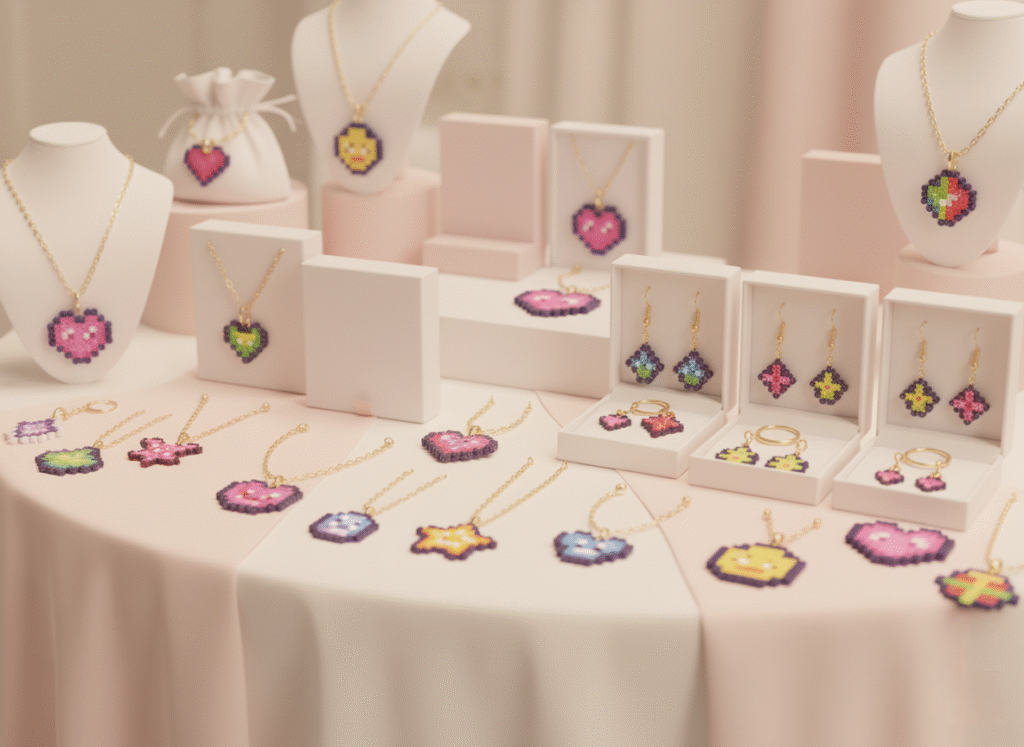
Jewelry & Keychain Applications
Fuse beads can replicate company logos, symbols, and colorful charms, allowing designers to produce unique:
- Pixel-style pendants
- Monogram keychains
- Geometric earrings
- Mini art brooches
- Seasonal or themed necklace sets
For private label buyers, combining fuse beads with stainless steel or plated alloy accessories creates a fusion product line that feels artisanal yet scalable.
Product Concept Examples
| Item Type | Core Material | Recommended Bead Material | Fusion Method | MOQ (OEM Production) |
|---|---|---|---|---|
| Keychains | Alloy/zinc + fused beads | C-series LDPE beads | High-heat press | 1,000 pcs |
| Earrings | Brass wire + fused beads | Mini H-Series (small bead size) | Moderate heat fusion | 500 pairs |
| Pendants | Stainless steel frame + fused beads | Standard 5mm C-Series | Industrial ironing machine | 300 pcs |
| DIY kits | Plastic pegboards + assorted colors | LDPE mix (bulk packs) | Consumer-level fusion | 1,000 sets |
Fuse bead jewelry fits into the creative DIY jewelry niche—a sector increasingly profitable for online brands selling unique or customizable designs.
What Should I Consider When Sourcing Fuse Bead Kits from Chinese Suppliers?
I’ve worked with dozens of Chinese factories offering both fuse bead components and complete DIY kits. Successful sourcing requires attention to material purity, melting compatibility, and packaging adaptability.
Supplier Verification & OEM Capability
Before placing bulk orders, assess whether your supplier can handle:
- OEM/ODM flexibility: Custom bead colors, logo printing, and private-label box design.
- Material consistency: Some suppliers mix LDPE and EVA plastics, which fuse differently.
- Export compliance: Verified certification like EN71, CE, or ASTM guarantees safety for retail markets.
- Stable color pigmentation: Bulk batches must match consistently for brand integrity.
Recommended Evaluation Checklist
| Evaluation Criteria | Key Metric / Question | Why It Matters |
|---|---|---|
| Bead composition | 100% LDPE vs mixed plastic | Ensures smooth fusion and durability |
| Color reliability | ±3% color tolerance | Prevents visible tone shifts in finished pieces |
| Heat resistance test | Melting range 170–185°C | Avoids deformation under normal ironing |
| Packaging quality | Box density & print clarity | Impacts retail perception |
| MOQ & lead time | Small-quantity flexibility | Enables test marketing before scaling |
| QC process | Random sample melting test | Confirms batch performance consistency |
Cost Comparison Table: OEM Kit Sourcing from China
| Product Type | Average FOB Price (USD) | MOQ | Lead Time | Customization Options |
|---|---|---|---|---|
| Fuse bead packs (10k pcs colors) | 0.009–0.012 per bead | 50,000 pcs | 20 days | Color mix + bag sticker |
| DIY pegboard set kits | 1.50–2.80 per set | 1,000 sets | 25 days | Box design + instruction sheet |
| Jewelry accessory kits | 0.80–1.60 per set | 500 sets | 20–30 days | Branded packaging, tag insert |
| Educational classroom kit | 24–28 per box | 100 boxes | 30–35 days | Multi-language manual |
When negotiating with Chinese suppliers, emphasize uniform bead diameter, stable fusion results, and eco-compliance. Ask for a sample fusion test before confirming the PO to rule out inconsistencies.
How Do I Ensure the Quality and Color Consistency of Fuse Beads in Bulk Orders?
Color consistency and fusion reliability are essential for branded jewelry and large craft orders. Inconsistent melting can ruin entire production runs.
Quality Control (QC) Standards for Fuse Beads
- Incoming Material Inspection: Verify bead diameter (typically 5mm ±0.1mm).
- Batch Sampling Test: Melt 100 beads using standard heat press and check surface smoothness.
- Color Stability Test: Compare melted vs unmelted bead tone under neutral light.
- Packaging QC: Ensure accurate labeling and lot-number traceability.
- Endurance Assessment: Conduct accelerated aging simulation under 60°C for 48 hours.
Bulk QC Flow
| Step | Action | Typical Defect Found |
|---|---|---|
| Incoming raw bead inspection | Visual + caliper check | Diameter variance |
| Fusion test on 10 random colors | Heat press at 180°C | Uneven melting |
| Color comparison | Digital spectrometer | Tone drift problem |
| Packing audit | Box drop & humidity test | Packaging deformation |
| Final pre-shipment review | Random sample re-melt | Material inconsistency |

Color Consistency Controls
Ask the supplier to maintain color master batches (original pigment formulation). Well-established factories digitally record color spectrometer readings to ensure ±3% tolerance per batch. For high-end jewelry design, this precision matters—especially if creating ombre gradients or branded palettes.
How Can I Customize Fuse Bead Packaging for My Brand or Retail Clients?
Custom packaging transforms fuse beads from simple craft items into polished, retail-ready products. As an OEM jewelry and accessories manufacturer, packaging often determines sales conversion.
Private Label Packaging Options
Fuse bead kits can be packaged in:
- Clear plastic jars or zip bags for hobbyist segment.
- Carded blister boxes for retail displays.
- Eco-friendly paper boxes for sustainability-driven brands.
- Combination kits (beads + pegboards + templates) for educational distributors.
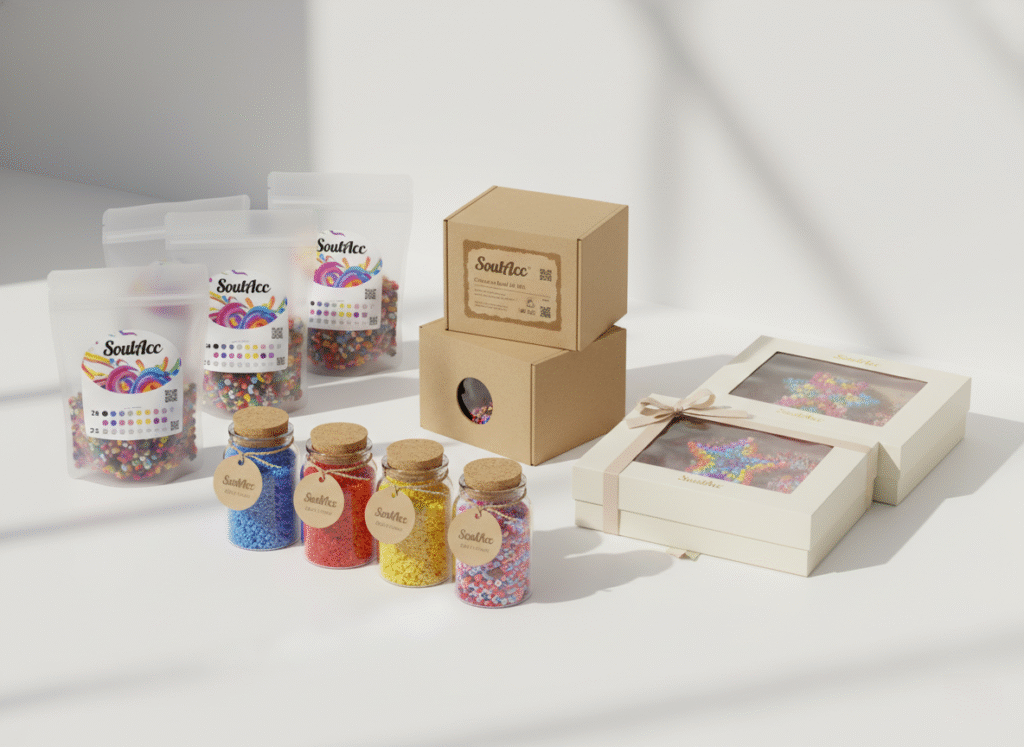
Packaging Customization Parameters
| Packaging Type | Material | Recommended Use | Customization Capability |
|---|---|---|---|
| Zip bag | PE bag + printed sticker | Mass hobby/filler item | Logo, color codes |
| Round jar | PET jar + PETG lid | Mid-tier retail | Label, logo emboss |
| Gift box | Cardboard + window | Private label gift set | Full-color CMYK printing |
| Eco box | Recycled kraft carton | Sustainability segment | Minimalist print design |
| Multi-kit | Carton + tray inserts | Educational and group use | Pattern booklets & color chart |
Consider adding:
- QR codes linking to brand tutorials.
- Branded instruction sheets for value addition.
- Barcode/UPC labeling for international retail compliance.
OEM partners in China generally handle design file input (AI/PDF format) and produce print samples within 5–7 days.
Packaging as a Brand Differentiator
For B2B jewelry and accessories brands, packaging isn’t just protection—it’s the storytelling layer. A creative box design elevates perceived product value, enabling higher margin sales even on low-cost craft materials like fuse beads. I’ve seen private labels command 30–50% higher retail pricing simply through consistent packaging aesthetics.
Market Outlook: Fuse Beads in the Global Craft and Jewelry Industry
Fuse beads now intersect multiple verticals:
- Educational Craft Kits: Growing at >12% CAGR globally.
- Custom Jewelry DIY Products: Riding the wave of personalization and gift culture.
- Eco-Friendly Craft Materials: Emerging biodegradable bead innovations aligning with sustainability trends.
Regional Demand Snapshot
| Region | Consumer Trend | Retail Channel Opportunity |
|---|---|---|
| North America | Retro gaming pixel art | Online handmade jewelry stores |
| Europe | Eco-craft products | Educational DIY kits & museums |
| Asia-Pacific | Colorful family craft kits | Gift, creative school segments |
| Middle East | Personalized corporate gifts | Promotional keychain customization |
The eco-shift and pixel design resurgence ensure fuse beads’ continued appeal for years. For B2B buyers, this means steady demand, scalable MOQ models, and smooth cross-category application—from jewelry to education.
Conclusion
Fuse beads remain a cornerstone of accessible creativity and customizable product development. Their enduring popularity stems from three key business advantages:
- Low material cost, high creative ROI—perfect for branded jewelry, gifts, and DIY kits.
- Scalable OEM potential—custom colors, patterns, and packaging help brands stand apart.
- Reliable sourcing from China—mature supplier ecosystems with QC control and eco material adoption.
For wholesalers, private label buyers, or craft distributors, fuse beads represent a proven entry point into the personalization market. Proper sourcing, color QC, and strategic packaging branding can turn these colorful beads into profitable retail products.
Ready to explore fuse bead production for your brand?
Contact your trusted custom jewelry supplier or Chinese OEM factory for samples and start building your branded collection today. Fuse beads aren’t just child’s play—they’re a business opportunity in miniature pixels.
