Diamond painting has rapidly evolved from a niche hobby into a serious global category for craft wholesalers and art kit distributors. As a manufacturer supplying OEM and private-label diamond art kits, I often get asked by sourcing managers and retail buyers: “What exactly is the difference between partial and full drill diamond paintings?” This distinction matters not just for the creative consumer experience, but also for how brands select SKUs, set pricing, and streamline production. Understanding these two styles can significantly impact cost efficiency, visual appeal, and target audience engagement in your product catalog.
A partial drill diamond painting covers only specific parts of the image—typically the main subject—with resin diamonds, while the background remains printed. A full drill covers the entire canvas with diamonds, creating a complete mosaic-like surface with uniform sparkle. For B2B buyers, this affects labor intensity, packaging size, material consumption, and ultimately retail margins.
Strategically, deciding between partial and full drill formats should align with your market positioning and buyer demographics. Full drills appeal to advanced hobbyists seeking immersive projects and fine details, while partial drills cater to beginners, gift buyers, and decorative craft enthusiasts. From a sourcing perspective, it’s not just a creative choice—it’s a production, inventory, and retail differentiation strategy worth mastering.
How Can I Identify Whether a Design Is Partial or Full Drill Before Ordering?
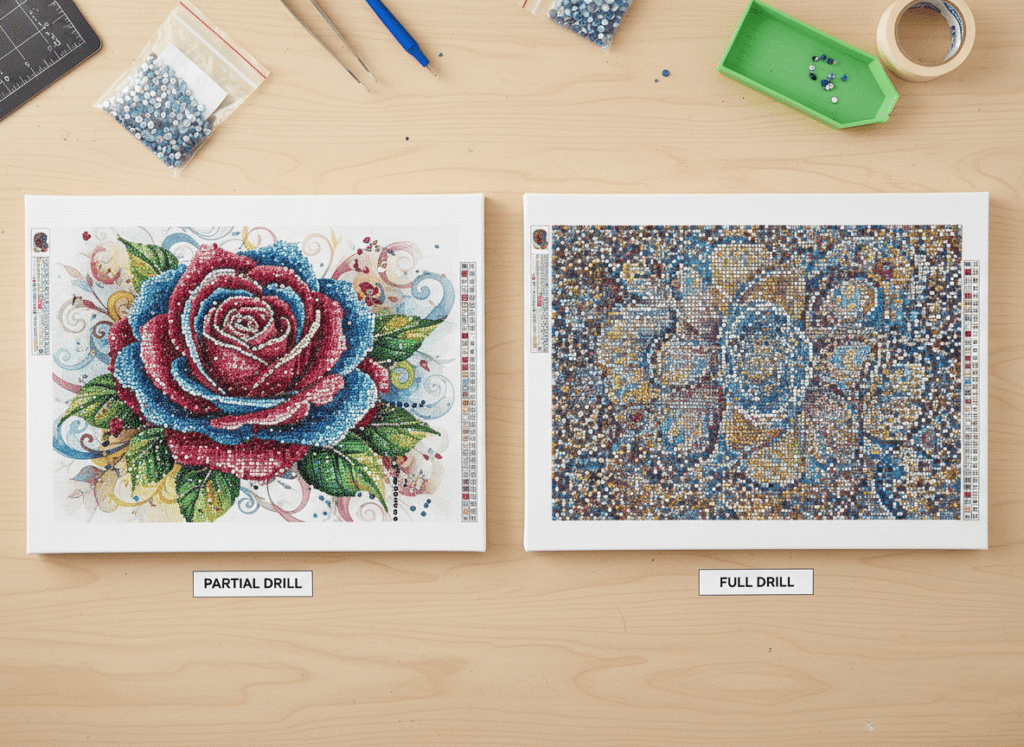
As a manufacturer, one of the most common questions I receive from new distributors and private-label brands is how to distinguish between partial and full drill canvases before placing bulk orders. Fortunately, identifying drill coverage is quite straightforward when you know what to look for.
Visual Indicators on the Canvas
- Printed Background Areas:
- In a partial drill design, large sections of the canvas—especially backgrounds—are clearly printed and lack adhesive.
- In contrast, a full drill canvas will display a uniform adhesive surface covering every pixel area.
- Canvas Charting:
- The color/number coding on full drill canvases extends edge-to-edge, sometimes even to the margin.
- Partial designs have limited coded sections focused around central motifs.
- Adhesive & Spec Sheet Review:
- The product specification or kit description should mention “partial drill” or “full drill.” Ask for the coverage ratio (%) during OEM sampling.
Example: Canvas Specifications Table
| Specification Element | Partial Drill Canvas | Full Drill Canvas |
|---|---|---|
| Adhesive Area Coverage | 40%–70%, subject-focused | 95%–100%, edge-to-edge coverage |
| Printed Background | Yes | No (entire surface covered by drills) |
| Drill Quantity per Kit | Fewer drills (cost-saving) | More drills (adds value weight) |
| Completion Time (Retail End) | 3–5 hours average | 15–20 hours average |
| Typical Buyer Segment | Beginners, kids, gifting segment | Hobbyists, collectors, advanced crafters |
Being able to visually and technically identify the type before ordering helps wholesalers communicate accurate product features, manage consumer expectations, and plan batch purchasing accordingly.
Why Do Manufacturers Offer Both Partial and Full Coverage Options?
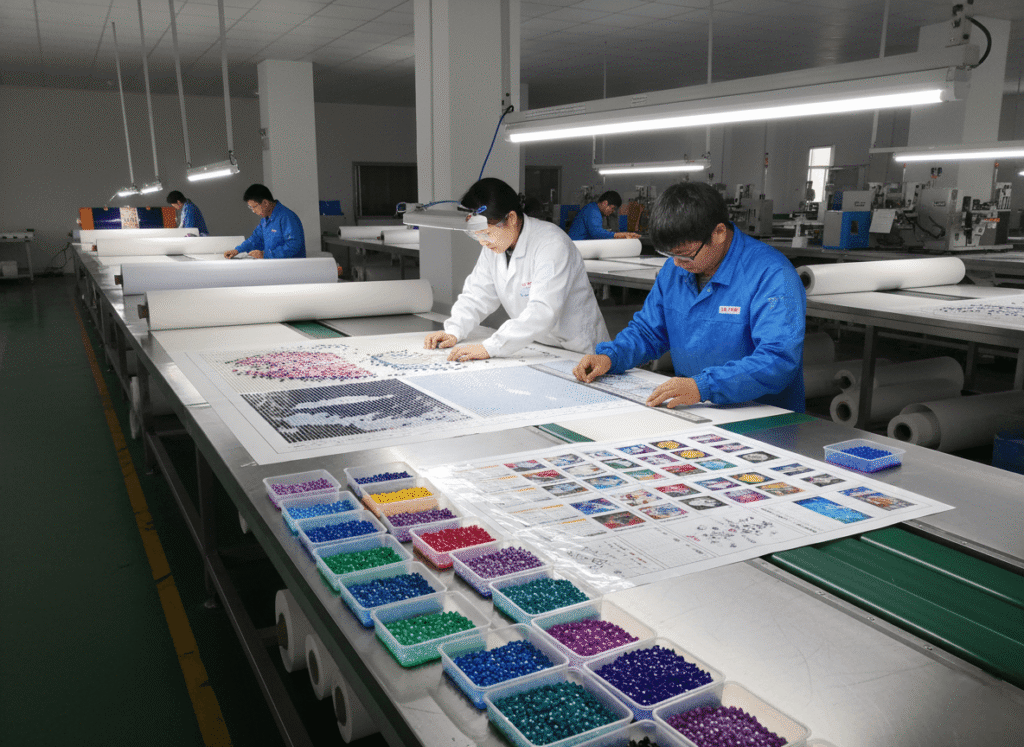
From a production perspective, offering both versions expands market reach and balances SKU portfolio diversity. As a custom diamond painting supplier, I produce both types because each serves different buyer needs and retail channels.
Product Diversification Strategy (OEM/ODM Perspective)
Partial Drill Kits:
- Lower production costs due to reduced drill quantity and adhesive application area.
- Ideal for quick gift sets, seasonal designs, children’s crafts, and lower price-points.
- Quicker assembly for sample pack runs and promotional kits.
Full Drill Kits:
- Higher perceived value, providing a detailed, fully jeweled effect.
- Favored for premium craft brands and collector-oriented product lines.
- Often chosen for licensed artworks and photo conversions where detail fidelity is crucial.
Offering both helps manufacturers reach distinct demographics:
- Partial drill kits attract entry-level buyers and gifting markets.
- Full drill kits engage serious DIY hobbyists and art collectors who prefer immersive projects.
Operational Manufacturing Insights
In OEM production, canvas coverage directly impacts:
- Material use: Glue consumption, drill quantity, and packaging volume.
- Labor time: Sorting and canvas prepping are shorter for partial kits.
- MOQ planning: Full drill kits often require larger MOQ due to higher component assembly and box specification accuracy.
Cost Comparison Example
| Cost Component | Partial Drill Kit | Full Drill Kit |
|---|---|---|
| Average Resin Drill Usage | 25,000 pcs | 65,000 pcs |
| Canvas Adhesive Coverage | 60% | 100% |
| Packing Weight (per unit) | 480g | 820g |
| Production Time (average) | Shorter (×0.6) | Longer (×1.8) |
| Suggested Wholesale Margin | Moderate | Higher (premium SKU) |
Manufacturers strategically use both formats to offer scaled price ranges and to serve different retail destinations—from craft supply shops to high-end creative brands.
How Does Each Type Affect Visual Impact and Production Cost?
When viewed from both an artistic and business standpoint, partial and full drill paintings deliver distinctly different visual experiences and cost dynamics, which influence how they perform at retail.
Visual Impact Differences
Partial Drill Visuals
- Focuses viewer attention on specific elements (portrait, flower, animal).
- Provides dimensional contrast—sparkly sections versus smooth printed areas.
- Often resembles semi-relief artwork, adding texture to only focal subjects.
Full Drill Visuals
- Creates a consistent, mosaic-style surface with homogeneous sparkle.
- Enhances color blending, pixel depth, and brightness uniformity.
- Produces professional finish quality suitable for framing or gifting.
For catalog presentation, high-resolution photos of the finished canvas help buyers perceive the textural difference. Full drills convey premium craftsmanship, while partial drills communicate light, playful creativity.
Production Cost & Efficiency Considerations
Partial drills offer:
- Reduced raw material consumption (fewer drills and glues).
- Lower shipping weight, beneficial for export scenarios.
- Higher throughput, allowing faster order turnaround for mass retail orders.
Full drills incur:
- Higher resin material volume, impacting supply chain cost.
- Extended QC inspection time, requiring verification of complete canvas adhesion and drill color distribution.
- Premium perception, supporting higher MSRP and brand positioning.
QC Standards and Inspection Criteria
In diamond art manufacturing, full drills undergo stricter QC due to full adhesive coverage:
- Uniform glue thickness and clarity.
- No printed gaps or matte zones.
- Color code alignment across entire matrix.
For partial drills:
- QC focuses more on outline accuracy and focal gem alignment.
- Visual balance between printed and jeweled sections is the primary benchmark.
Which Type Should I Choose for My Customers or Retail Store Inventory?
Deciding between partial or full drill formats should come down to target consumer profile, retail price positioning, and desired product turnover speed.
For B2B Wholesalers and Retail Chains
Start with Partial Drill Kits if entering new markets:
- Lower inventory risk.
- Broader audience appeal (children, casual crafters, gift segment).
- Faster turnover due to shorter crafting time for end-users.
Expand with Full Drill Collections once brand engagement grows:
- Appeals to advanced hobbyists and repeat buyers.
- Creates premium tier SKUs, improving average order value.
- Adds credibility and artistic depth to the catalog.
Inventory Planning Recommendations
| Parameter | Recommended Type for Retail Launch | Notes |
|---|---|---|
| Entry-Level/Budget Line | Partial Drill | Easy starter kits; ideal for online gift shops. |
| Mid-Tier Craft Collection | Mix of Partial & Full | Diversifies audience reach; boosts basket size. |
| Premium Artistic Line | Full Drill | For framing, exhibitions, and collector gifts. |
| Holiday & Promotional Campaign | Partial Drill | Lower cost, fast-selling decorative designs. |
Private Label or OEM Strategy Tips
When producing for private-label brands, I usually guide clients to plan product lines by coverage ratio:
- Include partial drills with simple subjects and vivid colors for impulse buys.
- Include full drills in limited-edition premium series featuring complex detail design.
Consumer Feedback Summary
- Beginners prefer partial drills for their simplicity and short completion time.
- Experienced hobbyists prefer full drills for intricate, high-sparkle projects.
- Retail managers prefer mixed inventory to serve diverse markets and pricing tiers.
Additional Considerations for Distributors and OEM/ODM Buyers
Supply Chain Cost Control & MOQ Planning
When arranging bulk production, coverage type affects MOQ and turnover rate.
For example:
- Partial drill: lower MOQ feasible (500–1000 sets).
- Full drill: typically requires higher MOQ (>2000 sets) due to material consumption efficiency.
Factory lead time also varies:
- Partial kits: 7–10 days average turnaround.
- Full kits: 14–20 days production cycle.
Packaging for full drill kits involves reinforced box structure to protect heavier canvas rolls.
Material Selection and Plating Analogy in Jewelry Industry
Interestingly, the visual logic of partial vs full drill diamond painting resembles that of plating coverage in jewelry production. A fully plated bracelet gleams uniformly—parallel to a full drill canvas—whereas a partially plated accent design highlights only focal features, similar to a partial drill kit. Both involve strategic balance between labor cost, aesthetic impact, and target buyer emotion.
The Future Market Trend: Balancing Detail with Accessibility
From my perspective as a manufacturer, the diamond art industry is evolving toward smart segmentation:
- Partial drills driving mass retail popularity and entry-level adoption.
- Full drills anchoring brand prestige and premium collections.
Upcoming innovations include semi-drill hybrid designs—halfway between partial and full coverage—optimizing creative appeal and production efficiency. As demand grows across craft e-commerce and department store chains, the distinction between partial and full drills will remain an essential classification parameter for product planners.
Conclusion
In summary, partial and full drill diamond paintings are far more than aesthetic variations—they represent distinct production workflows, target audiences, and retail values. Partial drills are fast, light, and affordable, emphasizing focal charm, while full drills deliver immersive sparkle and artistic completeness. For jewelry-like visual craft collections, full drills provide a luxurious finish; partial drills offer creative versatility and rapid turnover.
Key sourcing insights:
- Verify adhesive coverage and drill quantity before ordering bulk.
- Match drill type to target customer profile and price tier.
- Control cost by balancing partial and full drill SKUs in catalog design.
Supplier selection tips:
- Request sample kits labeled “partial” and “full” to inspect quality traits.
- Confirm lead times and MOQ relevant to canvas coverage.
- Evaluate packaging durability—particularly for full drill canvases.
