
Logical thinking is one of the most vital skills children can develop—it’s the foundation for reasoning, planning, problem-solving, and creativity throughout their lives. As both a parent and craft educator, I’ve seen how hands-on creative projects help children strengthen not just artistic abilities but also critical cognitive processes. Whether in the classroom, at home, or in after-school programs, specific crafts—especially those that blend design and engineering principles—encourage structured thought, cause-and-effect awareness, and organized creativity.
Crafts that best support logical development include building and construction projects (LEGO, model-making, and paper engineering), puzzle and pattern crafts (jigsaw, Sudoku, and tessellation art), STEM-based DIY activities (coding robots, circuits, magnetic slime), and upcycling or problem-solving crafts like recycled material inventions. Each of these activities requires children to plan steps, analyze outcomes, and adjust their approach—mirroring the same reasoning skills used in science, math, and real-world problem-solving.
From choosing safer materials to balancing creativity with challenge, crafting for cognitive growth means giving children opportunities to design, test, and improve through play. In this guide, I’ll share how parents and educators can select the right DIY kits, craft types, and materials that foster logical sequencing, planning, and structured creativity while ensuring fun and safety for every child.
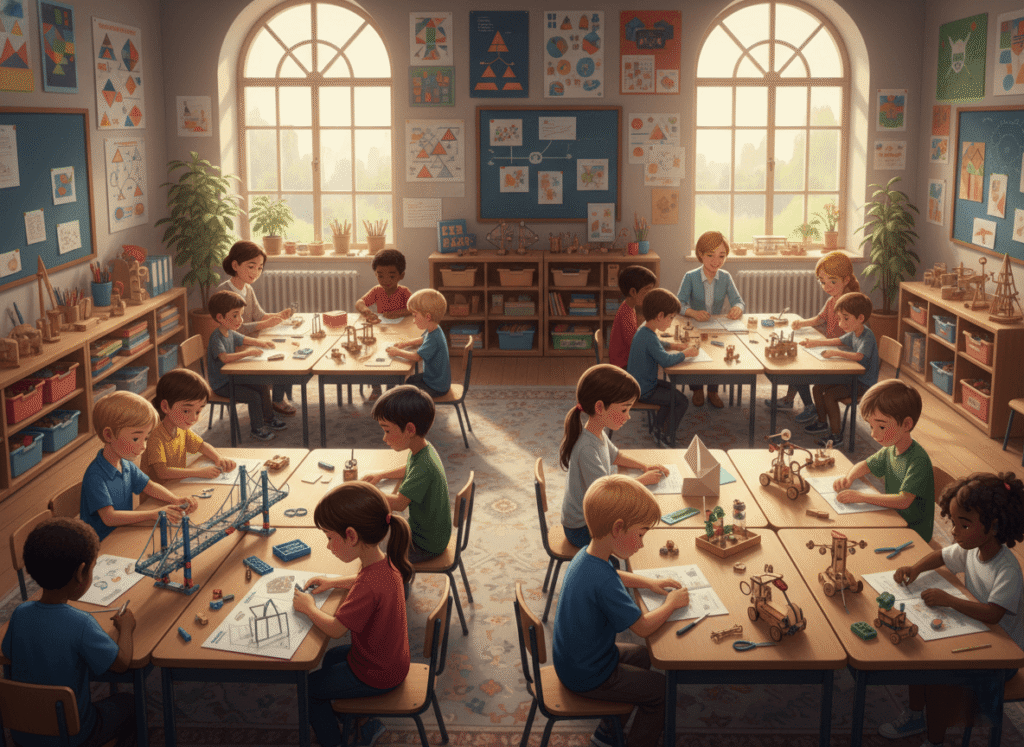
How to Choose DIY Kits That Develop Problem‑Solving and Planning Skills
Children benefit most from crafts that challenge them to think before doing. A well-designed DIY kit should invite prediction (“What will happen if I…?”), experimentation, and adjustment based on results. When selecting kits for logical skill-building, I recommend considering the following elements:
1. Structured Yet Open‑Ended Design
A good kit strikes a balance between instruction and freedom. For example:
- Engineering-themed construction sets (e.g., LEGO Technic, K’NEX) include diagrams to follow but encourage custom modifications.
- Model-making kits with blueprints strengthen sequencing by requiring careful step tracking.
- Origami sets allow for artistic creativity but develop precision, sequencing, and patience.
2. Real Problem to Solve
Kits that ask learners to design a bridge, make a car that rolls, or create a robot that moves introduce authentic challenges. As children test theories, troubleshoot, and iterate, they internalize scientific thinking.
3. Step-by-Step Logic Reinforcement
DIY kits can explicitly teach planning by breaking projects into numbered stages or requiring pattern recognition. Examples include:
- Coding robots where children connect instructions to actions.
- Chemical reaction kits encouraging observation and inference (“Did it fizz the same way? Why or why not?”).
4. Components for Independent Planning
Look for sets that include:
- Spare pieces for multiple outcomes
- Clearly labeled parts
- Opportunities to rebuild or repurpose creations
| Evaluation Criteria for Logic-Building Kits | Ideal Kit Feature | Cognitive Skill Developed |
|---|---|---|
| Sequential Instructions | Step-based assembly | Logical order & memory |
| Open-ended outcome | Multiple end designs | Creativity within structure |
| Materials variety | Mix of textures, shapes | Visual-spatial flexibility |
| Results testing stage | Performance trials | Hypothesis & analysis |

Jewelry-Making and Accessory Crafts That Teach Logical Sequencing
Many parents overlook jewelry-making as a STEM-compatible craft—but in truth, beading, pattern creation, and accessory design can all reinforce sequence-based reasoning, counting, and pattern visualization. Here’s how:
Patterned Beading: The Art of Organization
Children who follow beading patterns exercise several cognitive processes:
- Sequencing: Learning to arrange beads by color, size, or symmetry.
- Predictive logic: Anticipating how a repeated pattern will look when elongated.
- Error detection: Spotting when a pattern is “off” and self-correcting.
Encourage children to design their own sequences—an essential part of algorithmic thinking used in computer coding.
Wirework and Assembly Kits: Cause and Effect in Action
Even simple craft wire or elastic cord projects introduce practical reasoning:
- Stretch too much → bracelet breaks.
- Skip a crimp bead → clasp loosens.
These tangible consequences reinforce structured thinking and step correctness.
Custom Jewelry Design for Kids
Customized kits where children design charms based on shape-matching or color logic foster both aesthetic judgment and rational order—perfect for integrating creativity and mathematics.
| Jewelry Craft Type | Logical Skill Strengthened | Example Activity for Kids |
|---|---|---|
| Bead Sequencing Kits | Pattern recognition, counting | Create a bracelet with color repetition |
| Charm Sorting Sets | Classification logic | Match charms by category or theme |
| DIY Friendship Bracelets | Algorithm-like thinking | Repeat knot sequences with variation |
Ensuring Crafting Materials Are Safe and Easy for Children to Use
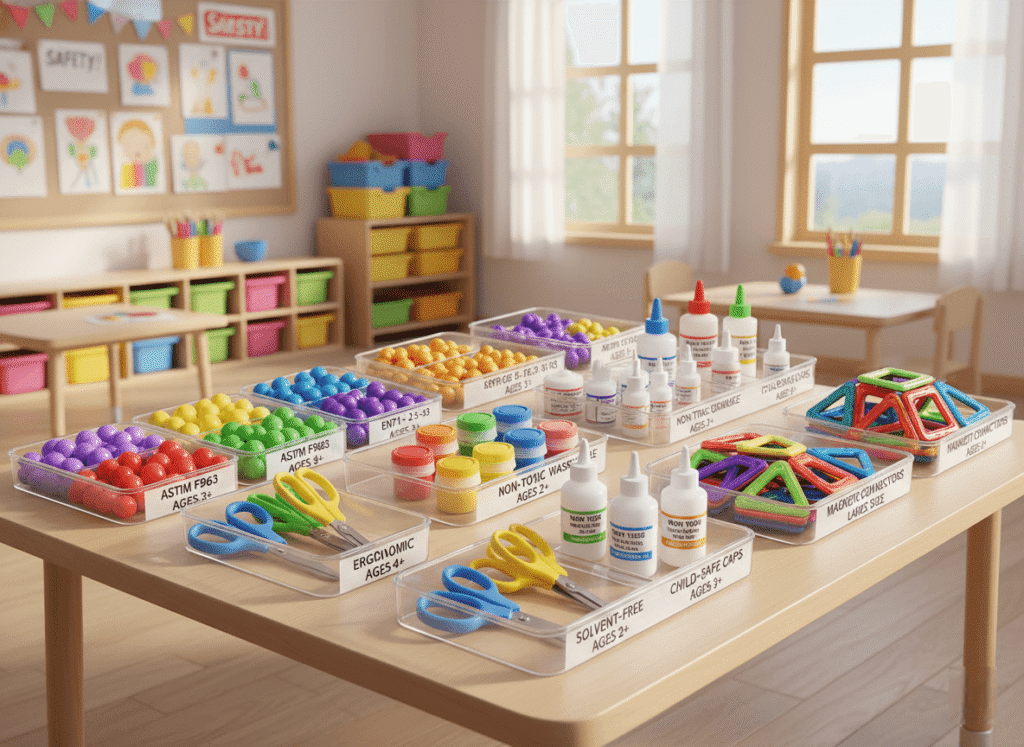
Safety is paramount—no cognitive gain outweighs the risk of unsafe materials. When working with kids, I always evaluate three major safety standards: toxicity, ergonomics, and durability.
1. Non-Toxic and Certified Materials
Check for ASTM D-4236 or EN71 certification labels. These indicate that glues, dyes, and polymer clays have passed toxicity evaluations. Especially for younger children (ages 3–7), opt for:
- Water-based paints and adhesives
- BPA-free plastic parts
- Nickel-free jewelry findings
- Rounded or coated metal edges for accessories
2. Ergonomic Design for Age Groups
Appropriate material sizing ensures safety and cognitive success:
- Age 3–5: Large, easy-grip building blocks and oversized beads to avoid choking.
- Age 6–9: LEGO, snap kits, and light jewelry assembly tools.
- Age 10–12: More advanced sets with modular logic (robotics kits, model construction, complex origami).
3. Maintenance and Reusability
Reusable kits encourage repeated cycles of planning and creation, embedding logic learning over time. Look for:
- Washable or resettable materials (e.g., magnetic pieces, detachable connectors)
- Storage-friendly systems that teach sorting—another executive skill developed through craft organization.
| Safety Factor | What to Check | Reasoning Skill It Supports |
|---|---|---|
| Toxicity | Non-toxic materials | Safe experimentation confidence |
| Durability | Crack- and shatter-resistant parts | Reliability testing and reassembly |
| Ergonomics | Child-friendly size & feel | Precise manipulation and control |
| Reusability | Modular and resettable design | Iteration and improvement logic |
How Customized Educational Craft Sets Support STEM and Creative Thinking Combined
The future of learning lies in craft-based STEM integration—using creativity to apply logic to real projects. Custom educational craft sets blend open-ended design with structured tasks, ideal for fostering balanced development between the left (logic) and right (creativity) hemispheres.
1. Combining Art and Engineering
Educational kits that merge design principles with technical construction—like jewelry circuits (LED necklaces) or 3D pen sculptures—make STEM accessible through art. Children see that structure and form are interconnected.
2. Introducing Coding Through Craft
Programmable craft robots or sensor-based wearable projects connect logical sequencing (code input) with tangible artistic results. Concepts such as “if this, then that” logic are easily understood through hands-on cause and effect.
3. Integration With Real-World Design Thinking
Customized craft kits can include steps such as:
- Problem definition – “Build a wearable light source.”
- Planning – Sketching, material selection.
- Building & Testing – Assembling circuits, decorating structure.
- Evaluation – Identifying what worked, redesigning for improvement.
This approach mirrors professional engineering cycles—yet in formats children find visually engaging and playful.
4. Benefits of Customized Educational Craft Sets
- Teach decomposition by breaking tasks into smaller parts.
- Encourage creativity guided by logic, friendly for multi-age classrooms.
- Reinforce STEM confidence, especially for young girls traditionally underrepresented in technical subjects.
| STEM Concept | Example Craft | Skill Developed |
|---|---|---|
| Engineering Principles | Straw-bridge challenge | Structural logic |
| Mathematical Thinking | Tessellation art | Geometric reasoning |
| Programming Concepts | DIY Coding robot | Sequential logic |
| Scientific Observation | Magnetic slime experiment | Hypothesis testing |

Additional Crafts That Support Logical Thinking
Beyond structured DIY sets, everyday household materials can become powerful teaching tools when used strategically.
Upcycling and “Frankentoy” Projects
Let children dismantle broken gadgets or toys and reuse their components creatively. This promotes analytical dissection (understanding how things work) and inventive problem-solving (deciding how to rebuild them differently).
Origami: Precision and Sequential Discipline
Origami is a masterclass in sequential logic. Each fold follows from the last, and one small error can alter the final result—teaching perseverance, precision, and stepwise reasoning. With diagram instructions, children practice visual translation—turning 2D images into 3D forms, directly linked to spatial and mathematical intelligence.
Strategy Board Games
Not all logic training happens with glue and scissors. Games like chess, checkers, and Rush Hour introduce predictive modeling—children assess moves ahead, anticipate opponents, and improve foresight, crucial for cognitive flexibility.
Guiding Children’s Logical Growth Through Crafts: A Holistic Perspective
Crafting isn’t just play—it’s a structured form of thinking disguised as fun. When a child chooses materials, follows steps, and re-evaluates results, they experience the core cycle of logic-based learning:
- Plan.
- Execute.
- Review.
- Refine.
With repetition, this process becomes second nature. Whether through a STEM-themed jewelry-making project or an upcycled construction challenge, logical reasoning turns from an academic concept into a lived experience.
Conclusion: Encouraging a Lifelong Love of Logic Through Creativity
In an increasingly technology-driven world, logical thinking forms the root of adaptability and innovation. When children manipulate pieces, follow ordered steps, and build something tangible, they learn to reason through processes—a skill that extends to math, science, and life.
To summarize:
- Choose structured yet flexible kits that balance instruction and creativity.
- Incorporate crafts with natural sequencing challenges, like jewelry-making and origami.
- Ensure materials are certified safe, ergonomic, and reusable.
- Blend STEM and art through customized craft sets that teach both rational design and creative problem-solving.
As you plan the next at-home or classroom project, remember that every fold, bead, and blueprint strengthens the logical pathways that shape young minds. Encourage open exploration, pose “what if” questions, and let the joy of crafting unlock the scientist, designer, and thinker within every child.
“When play meets purpose, logic grows naturally.”
