
Fuse beads are an unexpected yet highly creative medium for jewelry prototyping, offering a way to transform handcrafted pixel art into tangible accessories. For jewelry wholesalers, brand owners, OEM/ODM factories, or private label buyers exploring innovative production methods, fuse bead design opens a cost-effective gateway into custom concept modeling. These colorful beads simplify pattern testing, helping visualize size, color, and shape before committing to metalwork or resin mold production—an invaluable step for any prototype stage.
Fuse beads allow jewelry designers and sourcing managers to quickly prototype designs, test color palettes, and evaluate proportions before large-scale production. By using pixel-based layouts, manufacturers can preview complex shapes, assess color balance under different lighting, and communicate specifications clearly to CAD designers and plating technicians. Ideal for sample validation, fuse bead prototypes help reduce mold errors, shorten lead time, and control production costs for custom wholesale jewelry lines.
From prototyping to quality sampling, the use of fuse beads streamlines communication between designers and production engineers. Whether you’re sourcing from a stainless steel jewelry manufacturer or developing a private label collection under an OEM/ODM arrangement, understanding fuse bead design workflows gives you an advantage when planning your supply chain, determining MOQ thresholds, and managing plating standards during scale transition.

How Can I Turn Fuse Bead Patterns into Jewelry Prototypes for My Brand?
As a custom jewelry supplier, I often start with basic fuse bead models to simulate charm dimensions and layout before preparing CAD drawings. These prototypes act like “2D molds” for conceptual visualization and proportion checking.
The Role of Fuse Bead Design in Jewelry Prototyping
Fuse beads are small thermoplastic cylinders arranged on a pegboard to create pixel-like images. When lightly fused with heat, they form a flat, durable pattern—perfect for translation into molds, laser-cut plates, or metal stamping dies.
How Fuse Bead Prototypes Support Design Workflow:
- Provide a quick tangible sample before CNC mold investment.
- Enable color testing across enamel or epoxy plating palettes.
- Showcase pattern geometry useful for product photography or packaging mockups.
Step-by-Step Transformation Process
- Pattern Drafting
Use a digital pegboard layout or graph-based software to position beads representing metal parts (gold, silver, stainless steel) and enamel zones. - Physical Bead Model
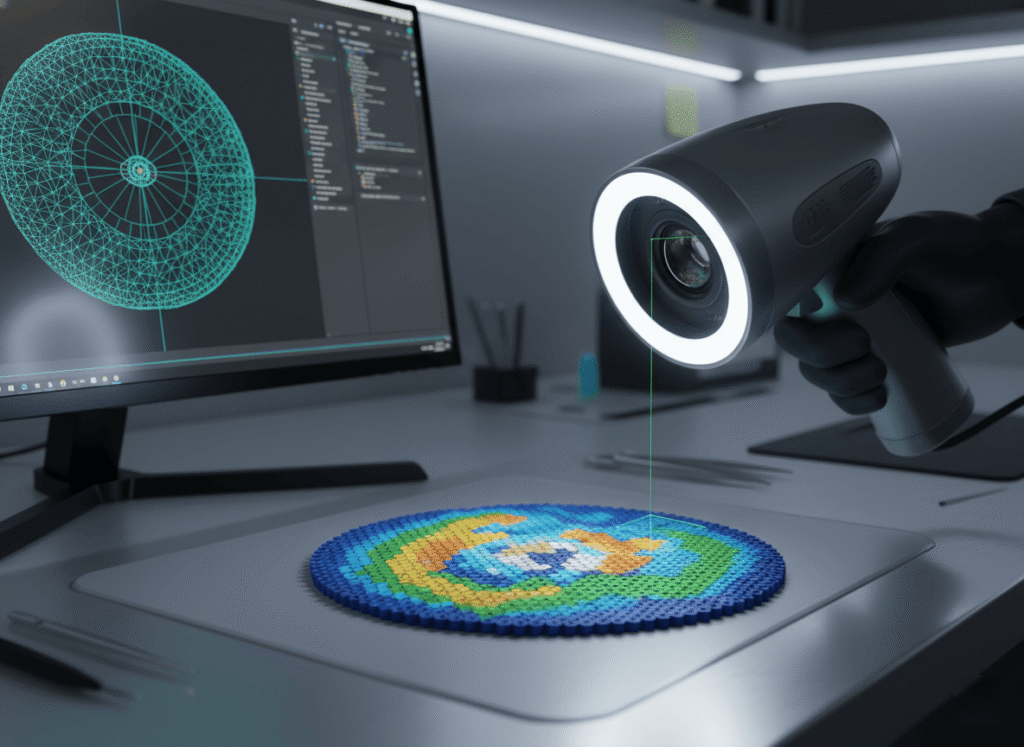
Place the beads on a pegboard, build the design, fuse it gently using parchment paper and an iron—creating a flexible prototype. - 3D Scanning & CAD Translation
Scan or photograph the fused bead design. Import it into CAD software (such as RhinoGold or MatrixGold) to measure outlines and scaling ratios. - Design Conversion for Jewelry Manufacturing
Convert the fused layout into a vector-based drawing suitable for mold creation or laser cutting. Adjust dimensions based on metal expansion tolerance.
Example Workflow Comparison Table
| Stage | Fuse Bead Task | Jewelry Production Equivalent |
|---|---|---|
| Design Planning | Grid layout of beads by color | CAD sketch or matrix design |
| Fusing & Cooling | Melt & stabilize bead prototype | Metal casting sample stage |
| Pattern Scanning | Image capture for scaling | Mold engraving preview |
| Final Testing | Durability test of bead sample | Plating or polishing test piece |
What Software or Design Process Should I Use to Plan Fuse Bead Jewelry Layouts?
Over the years, I’ve tested several layout tools to bridge bead artistry with B2B jewelry design precision. In professional settings, the goal isn’t just to make a colorful craft—it’s to translate pixel-based visuals into scalable manufacturing-ready files.
Recommended Software
| Purpose | Software | Features for B2B Jewelry Design |
|---|---|---|
| Pattern Draft | BeadTool 4 / Perler Design Studio | Simulates color palette; exports grid prints |
| CAD Conversion | RhinoGold / AutoCAD / Adobe Illustrator | Vector precision for mold drawing |
| Production Mockup | Blender / Fusion 360 | 3D modeling for metalwork prototypes |
| Color Calibration | Photoshop / CorelDRAW | CMYK/RGB adjustment for plating simulation |
Process Overview
Step 1: Pattern Design
Start with fuse bead layout visualization, focusing on symmetry and bead positioning relevant to charm designs or earrings.
Step 2: Material Mapping
Assign virtual materials (brass, alloy, stainless steel) to specific bead groups. This mapping defines plating zones, engraving depth, and chain attachment points.
Step 3: Color Simulation & Scaling
Fuse beads act as placeholders for enamel or inlay areas. Apply real plating tones digitally—gold, rhodium, black gunmetal—to visualize final effects.
Step 4: Export & Engineering Communication
Export design files in AI/DXF formats for CNC mold engineers or metal artisans. This ensures pattern fidelity and reduces toolpath errors during engraving.
How Do I Adjust Bead Sizes and Color Matching for Bulk Production?
Adjusting bead scale and color correlations is essential for mass jewelry manufacturing. In-house, we use fuse bead samples to estimate the holographic spacing and enamel fill ratios required for large-volume casting.
Bead Size vs. Jewelry Scale Conversion
| Fuse Bead Diameter | Equivalent Jewelry Component | Recommended Material Translation |
|---|---|---|
| 2.6mm (Mini beads) | Small charm / stud earring | Zinc alloy / brass |
| 5mm (Standard beads) | Pendant / brooch base | Stainless steel / copper |
| 10mm (Large beads) | Statement jewelry / cuff | Alloy / resin / mixed metal |
Larger beads yield clearer pixel effects but may require refined metal curvature; smaller beads are more suitable for detailed jewelry accents, mirroring gemstone placements or filigree texture.
Color Matching and Sampling
When converting bead colors to plating tones or resin fills:
- White beads → mimic rhodium or platinum plating.
- Black beads → represent gunmetal or oxidized finishes.
- Yellow beads → simulate gold plating variations (14K, 18K).
- Pastel beads → used for epoxy enamel accent representation.
Tips for B2B Buyers:
- Request a color-matched bead matrix as part of OEM/ODM sample approval.
- Define Pantone references for enamel areas to match production consistency.
- Include bead-based sample photos in your QC document to standardize plating interpretation across suppliers.
MOQ Strategy Based on Bead Prototypes
Fuse bead prototypes are ideal for showcasing new jewelry lines before committing to high MOQs. For small batch collections or test launches:
- Perform bead mockups for 3–5 key SKUs.
- Gauge market response.
- Scale into 500–1000 pcs MOQ per style once mold data is validated.
This minimizes development waste while sustaining consistent color coordination in bulk runs.
How Can Design Samples Help Control Final Jewelry Quality Before Mass Manufacturing?
Design sampling is the bridge between creative concept and commercial-grade execution. As a stainless steel jewelry manufacturer, I rely on fuse bead prototypes to maintain alignment between designer intent and metal accuracy.
Sampling Objectives
- Structural Verification: Ensure holes, links, and engravings correspond correctly to the bead grid.
- Color Accuracy: Validate plating or epoxy tones against the original fuse bead palette.
- Dimensional Precision: Compare pixel density to casting shrink rate (usually around 3–5% for stainless steel and brass).
Quality Control Integration
Fuse bead samples can be incorporated directly into QC documentation before production batches. This eliminates ambiguity about design shape, bead diameter, or color transition.
Sample Inspection Checklist:
| QC Criterion | Inspectable Aspect | Bead Prototype Utility |
|---|---|---|
| Shape Accuracy | Verify outlines vs CAD renders | High pixel ratio precision |
| Color Consistency | Compare plating and enamel | Clear visual mapping from bead prototype |
| Surface Finish | Smoothness / polish | Reference for texture expectation |
| Size Verification | Overall width, height | Scale check with bead-to-metal conversion |
Pre-Production Collaboration
Before full-scale casting:
- Submit bead sample photos to your OEM/ODM supplier.
- Review their 3D prototype render against your bead reference.
- Approve after confirming alignment in plating color and structural detail.
This iterative process can reduce mold alteration costs by 30–40%, accelerating go-to-market timelines.
Additional Insight: Material Selection and Cost Control for Fuse Bead-Inspired Designs
From bead-based inspiration to metal fabrication, understanding material behavior is vital for cost optimization. Here’s a comparative summary useful for bulk procurement evaluation.
Material Comparison Table
| Material | Durability | Color Retention | Cost per Unit | Typical Jewelry Use |
|---|---|---|---|---|
| Stainless Steel | Excellent | High | Moderate | Long-wear fashion jewelry |
| Brass | Good | Medium | Low | Earrings / Costume jewelry |
| Zinc Alloy | Moderate | Medium-Low | Very Low | Promotional jewelry lines |
| Sterling Silver | Excellent | High | High | Premium label accessories |
Fuse bead-based CAD designs can flexibly adapt across all these material grades, allowing brands to pivot between premium and affordable collections seamlessly.
Global Market Trend Analysis: Creativity Meets Manufacturing Efficiency
Across Europe and Asia, design houses integrate artisanal crafting with automated production to offer custom jewelry at scale. Fuse bead modeling aligns perfectly with this hybrid strategy:
- Fast design validation for new seasonal drops.
- Precise color communication between design and plating departments.
- Reduced sample lead time, expediting catalog turnarounds.
Wholesalers and distributors increasingly request digital bead layouts from OEM partners before confirming mold fees—evidence that rapid prototyping has become standard in high-volume jewelry sourcing.

Conclusion: Fuse Bead Design as a Bridge Between Creativity and Commercial Scale
Fuse beads are far more than playful craft materials—they’re practical design tools for fast, cost-effective prototype visualization in jewelry manufacturing. By integrating bead modeling into your sourcing workflow, you gain:
- Clear pattern communication for mold engineers.
- Reliable color referencing for plating consistency.
- Scalable visual validation prior to mass production.
For B2B buyers and private label brands, adopting fuse bead prototyping helps control quality from design inception to final bulk shipment. Whether your focus is stainless steel fashion jewelry or mixed alloy collections, early sampling transforms development efficiency and supplier collaboration.
Next Step:
Explore sample creation or request a bead-to-CAD conversion template. Connect with your sourcing partner or contact your jewelry manufacturer to discuss OEM/ODM sample workflows inspired by fuse bead design methods—an intelligent way to merge artistry with industrial precision.
