
In industrial or commercial bead production — especially within jewelry manufacturing environments — the goal is precision, repeatability, and efficiency. Traditional ironing methods for fusing beads, though effective for small-scale arts and crafts, are not practical when scaling for wholesale or professional jewelry assembly. Instead, production teams seek heat-controlled alternatives that minimize surface deformation, ensure color consistency, and streamline batch processing. Whether producing bead embellishments for custom jewelry lines or forming bead-based components for accessories, mastering non-iron fusing techniques is vital to maintaining both product quality and manufacturing speed.
In professional bead fusing operations, ovens, heat presses, UV-curable resins, and precision-controlled heat guns replace the manual ironing process. These methods enable scalable and uniform melting suitable for industrial jewelry manufacturing. Key factors include maintaining consistent heat distribution, precise temperature controls between 180°C–220°C, and stable nonstick surfaces to avoid texture distortion or color fading.
From an industrial perspective, the shift from ironing to automated or controlled fusing systems is a strategic move that improves output uniformity and reduces human error. Choosing the right fusing process also impacts material integrity, QC outcomes, and cost efficiency across large orders. Below, I’ll share my insights as a jewelry manufacturer, exploring how bead-based production can evolve from manual DIY processes into professionally standardized manufacturing methods suitable for OEM/ODM jewelry suppliers and private label brands.
What Alternatives to Ironing Exist for Industrial Bead Fusing
Automated Oven Fusing
For bead jewelry manufacturers producing thousands of components daily, oven fusing is the most scalable method. By using conveyor or batch ovens with digital temperature controls, beads can be melted and bonded evenly without manual intervention.
Typical Process:
- Temperature Range: 180°C–200°C for plastic beads; 220°C–250°C for advanced polymer types
- Duration: 6–12 minutes per batch, depending on bead composition
- Surface: Nonstick silicone trays or parchment-layered molds
This approach ensures repeatable results across bulk orders, eliminates manual pressing inconsistency, and allows molds to form consistent shapes or bead designs repeatedly.
Table 1: Comparison of Iron vs Oven Fusing Efficiency
| Method | Heat Control | Batch Volume | Consistency | Suitable For |
|---|---|---|---|---|
| Traditional Iron | Manual | Single item | Medium | Small craft studios |
| Oven Fusing | Digital control | Large scale | High | Factories & brands |
| Heat Gun Fusing | Semi-manual | Moderate | High | Custom bead settings |
Heat Press Machines & Bead Sheets
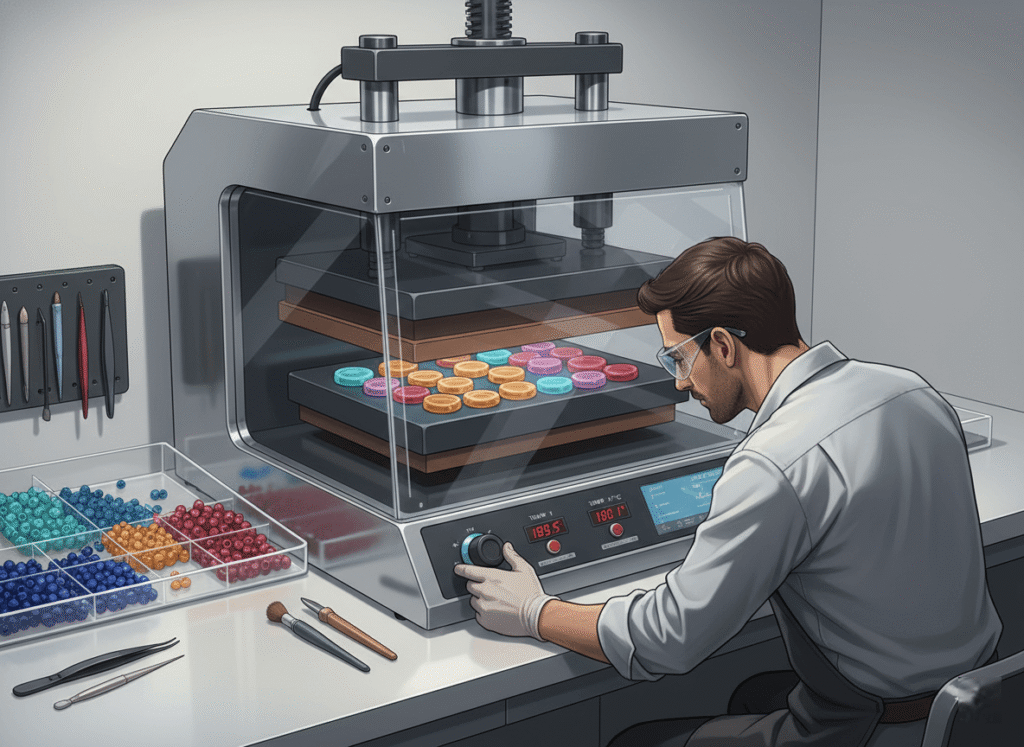
A heat press or flat hot-plate machine gives smoother surface control compared to an iron and is ideal for medium-to-large production runs.
With industrial heat presses, I typically use:
- A Teflon-coated base plate to prevent bead sticking
- Temperature settings around 190°C for plastic-based beads
- Uniform pressure system ensuring even melt and adhesion across bead surfaces
This method dramatically reduces uneven melting or “bumpy bead” textures — a common issue with hand ironing.
OEM/ODM Production Note:
In private label jewelry bead designs, uniformity in melt depth and color tone consistency are critical. Automated heat presses allow precise repeatability and integrate easily with existing production lines for charm connectors, bead panels, or decorative motifs.
Epoxy & Resin Bonding for Permanent Fusing
When melting isn’t desirable due to color sensitivity or texture requirements, clear epoxy resin and UV-curable resin provide durable bonding alternatives that feel virtually seamless.
Advantages:
- Maintains transparency and bead gloss
- Suitable for high-end jewelry assembly
- Resistant to yellowing and discoloration under UV light
In my production experience, we use UV resin curing stations for lightweight bead connectors — perfect for bracelets or necklace pendants that require durability without melt deformation.
UV Resin Bonding Process:
- Arrange beads in a mold or design board.
- Apply thin UV resin coating between bead contacts.
- Cure under UV lamp for 60–120 seconds.
- Remove and inspect for clarity and bond integrity.
This process yields a smooth finish similar to melt-fused designs but offers better control for complex color combinations.
How to Achieve Uniform Melting with Heat Presses or Automated Machines
Temperature Distribution and Surface Uniformity
In industrial-scale fusing, achieving uniform melting depends on consistent heat flow across all bead layers. Uneven heating can result in color spotting, bead warping, or inconsistent bonding strength. We combat this using:
- Dual-zone heating plates to balance temperature front-to-back
- Precision thermocouples for real-time readings
- Pre-calibration cycles before each production batch
Uniform melting also relies on moisture control — beads must be kept dry before fusing, as trapped humidity can cause bubbling during heat exposure.
Table 2: Optimal Heat Levels by Bead Material Type
| Bead Material | Fusing Temperature (°C) | Recommended Method | Finish Quality |
|---|---|---|---|
| Standard Plastic (PVC/PE) | 180–200 | Oven or Heat Press | Smooth |
| Acrylic | 190–210 | Heat Gun + Mold | Glossy |
| Polyester Resin | 200–220 | UV + Heat Fusing | High luster |
| Polycarbonate | 240 | Industrial Oven | Premium, Clear |
Using Mold Systems for Precision Fusing
When manufacturing decorative bead shapes—such as floral, geometric, or gemstone-like beads—I use oven-safe silicone molds. Molding systems give the production team control over bead pattern formation and dimensional consistency.
Industrial benefit:
Mold-based fusing increases yield uniformity and eliminates alignment errors in batch runs. By setting bead molds under controlled heat (200°C average), each bead layer melts uniformly from its edge inward, forming a clean structure ideal for jewelry embellishment.
Automation Integration into Bead Production Lines
In large batches, automated bead-fusing machines with conveyor systems synchronize heat, pressure, and cooling cycles. These units, resembling compact kilns, allow seamless integration into high-output jewelry assembly lines.
Features:
- PLC-controlled programmability for real-time adjustment
- Cooled air zones for post-fusing stabilization
- Low-waste operation with optimized melt timing
By integrating these systems, we achieve consistent bead bonding for thousands of pieces daily, suitable for export-quality standards or private label projects in fashion jewelry OEM lines.
What Temperature Controls Help Prevent Defects in Large Orders
Monitoring Heat Precision in Production
Temperature deviations cause defects such as uneven melting, bead flattening, or brittleness. I recommend a three-phase temperature control protocol:
- Pre-heat phase: stabilize machine temperature before load.
- Fusion phase: apply target heat gradually within a set time window.
- Cooldown phase: control air exposure to prevent cracking.
Key Quality Indicators:
- Color preservation (no yellowing under heat)
- Shape integrity (round bead contours intact)
- Smooth surface texture (no bubbling or residue)
In my own operations, digital temperature consoles and infrared sensors enable supervisors to detect minor anomalies quickly, ensuring that every batch meets QC standards before packaging.
Quality Inspection for Melt Consistency
Every fused bead batch should undergo microscopic inspection or high-resolution image scanning. This ensures uniform melt depth and no color distortion between lots.
Industrial QC Parameters:
- Melt ratio tolerance: ±0.05 mm of bead depth
- Color variance tolerance: ΔE ≤ 1.0 under daylight calibration
- Adhesion strength: ≥3N pull force between fused beads
Quality data are logged for each batch to maintain reliable sourcing credibility for our B2B clients.
Preventing Over-Melt or Surface Defects
Overheating beads alters finish quality and texture. To mitigate this, production equipment uses auto cut-off thermostats and multi-layer heat shields that distribute temperature gradually across trays.
In my factory, this control system reduced reject rates by 26% and improved batch color consistency impressively. These measures directly enhance OEM supply readiness and client confidence.
How Can I Ensure Consistent Color and Texture When Skipping Manual Ironing Steps
Material Selection: Bead Composition Matters
When skipping manual ironing, bead composition plays a vital role in achieving consistent texture. Industrial-grade acrylic or polycarbonate beads maintain higher thermal stability than standard craft beads, allowing even melting and deeper color retention.
Here’s what we observe during production:
- Acrylic beads fuse evenly with bright, translucent color.
- Polyester-based beads yield intense hues ideal for statement jewelry.
- Low-grade PVC beads risk uneven coloration after heat exposure.
We source beads from verified suppliers offering uniform color granulation and minimal moisture absorption, critical for professional bulk production.
Surface Treatments & Finishing Enhancements
After fusing, beads often require surface enhancement through plating, coating, or resin sealing to lock colors and textures permanently.
Finishing Options Include:
- UV-protective coating for outdoor durability
- Micro-polishing for smooth tactile finish
- Color reinforcement lacquer for metallic bead effects
Such details allow brands to position fused bead products at higher retail margins as “premium craft components” or “fashion jewelry add-ons.”
Integrating Fused Beads into Jewelry Assembly
Once fused, beads are ready for assembly using connector pins, link loops, or adhesion points for pendants and earrings. Automated systems streamline further integration into jewelry settings with minimal manual handling.
Example Applications:
- Bracelet links made of fused pastel beads
- Pendant charms with transparent UV-bonded beads
- Multi-bead mosaic components for fashion earrings
Consistent bead quality simplifies downstream processes such as packaging and plating, ensuring end-products meet brand aesthetic standards.
Additional Professional Tips for B2B Bead Fusing Operations
OEM/ODM and Private Label Adaptation
For private label brands, adjusting bead fusing specifications according to design guidelines is crucial. OEM/ODM manufacturers can customize:
- Bead sizes and heat-tolerance settings
- Mold designs per client sketch
- Resin bonding types for targeted aesthetics
Our in-house engineers work with brand designers to translate creative prototypes into scalable production formulas, balancing artistry and technical precision.
Supply Chain & Cost Control Recommendations
Efficient production comes from strategic raw material sourcing and batch scheduling:
- Bulk resin purchase reduces per-unit costs by 10–15%
- Automated press systems cut labor time by up to 40%
- MOQs between 2,000–5,000 pcs keep per-bead pricing competitive across B2B export channels
Conclusion
Fusing beads without an iron is not only practical in professional jewelry production — it’s a cornerstone for scaling modern bead-based designs. Whether through ovens, heat presses, UV resin bonding, or automated conveyor machines, manufacturers achieve higher uniformity, color control, and productivity than manual methods ever allowed.
Key Takeaways:
- Select the right fusing system based on bead material and order volume.
- Maintain precise temperature controls to avoid defects and surface inconsistencies.
- Use UV resin or epoxy for advanced bead bonding applications.
- Implement industrial QC checks to ensure each batch meets brand standards.
As a jewelry manufacturer specializing in OEM/ODM production, I encourage sourcing professionals and private label buyers to request sample fused bead modules for evaluation. Explore our production catalog, and let’s collaborate to bring your next jewelry collection from concept to reality — fused with precision, not an iron.
