
In the B2B fashion jewelry industry, efficiency in design and production directly impacts profitability, branding consistency, and turnaround times. When creating matching jewelry sets from one DIY kit, manufacturers, wholesalers, and private-label buyers must navigate both creativity and systemized design planning. This balance helps maintain the quality standards that determine retail success and brand reputation. Whether you’re a stainless steel jewelry manufacturer, a custom jewelry supplier, or an ODM design studio, your approach to coordinating necklace and bracelet sets defines your collection’s commercial appeal.
Matching necklaces and bracelets crafted from the same jewelry-making kit achieve visual harmony by using unified plating tones, focal charms, and bead progressions. The key is to plan proportional distribution—larger centerpiece beads for necklaces, smaller repeats for bracelets—and standardize materials. For OEM/ODM production, ensure consistent plating baths, thickness standards (≥0.03 microns for gold IP plating), and QC criteria before mass replication.
From DIY kits to large-scale OEM manufacturing, matching jewelry sets demand strategy. Beyond aesthetics, suppliers must manage plating color uniformity, raw material allocation, and minimum order quantities (MOQs). In this article, I’ll explain how professional jewelry suppliers use design kits as prototypes for scalable production, offering insights into design balance, plating consistency, and wholesale quality control.

Understanding Kit Components and Design Symmetry
Effective jewelry design begins with material awareness. When sourcing or designing from a single kit, the first step is to classify every part—metal findings, beads, chains, and charms—by color, type, and intended purpose. This method mirrors professional production planning used in wholesale environments.
Key Kit Elements for Matching Sets
Most wholesale-ready kits contain standardized components:
| Component Type | Use in Necklace | Use in Bracelet | Material Consideration |
|---|---|---|---|
| Chain or Beading Wire | Establishes main length structure | Connects short repetitive segments | Stainless steel or brass preferred |
| Clasps (Toggle, Lobster) | Closure system | Closure & visual accent | Match plating tone and base alloy |
| Charms/Pendants | Center focal or theme piece | Accent repetition or mini-charm | Consistent IP plating or e-coating |
| Beads | Color gradient formation | Repetition or rhythmic patterns | Match size and color grade |
| Jump Rings & Crimps | Assembly integrity | Assembly integrity | Nickel-free brass preferred for plating |
By controlling these material variables, OEM and private-label suppliers ensure both design continuity and production consistency across the set.
Sourcing Strategies for Scalable Set Production
As a supplier experienced in fashion jewelry wholesale from China, I always start small—testing unified set designs through modular kits. Once a harmonious prototype is established, it becomes an ideal model for OEM bulk production. This approach facilitates faster client approval and minimizes plating variation between batches.
OEM/ODM Steps for Matching Set Development:
- Prototype with DIY kit – Creates design flow and theme.
- Material standardization – Convert kit components into production-grade metal alloys.
- Plating sample test – Check tone under daylight vs studio light.
- QC inspection criteria setup – Define 2.5 AQL tolerance levels for plating adhesion and bead color matching.
- Bulk execution under MOQ – Minimum 200–500 sets for uniform bath treatment efficiency.
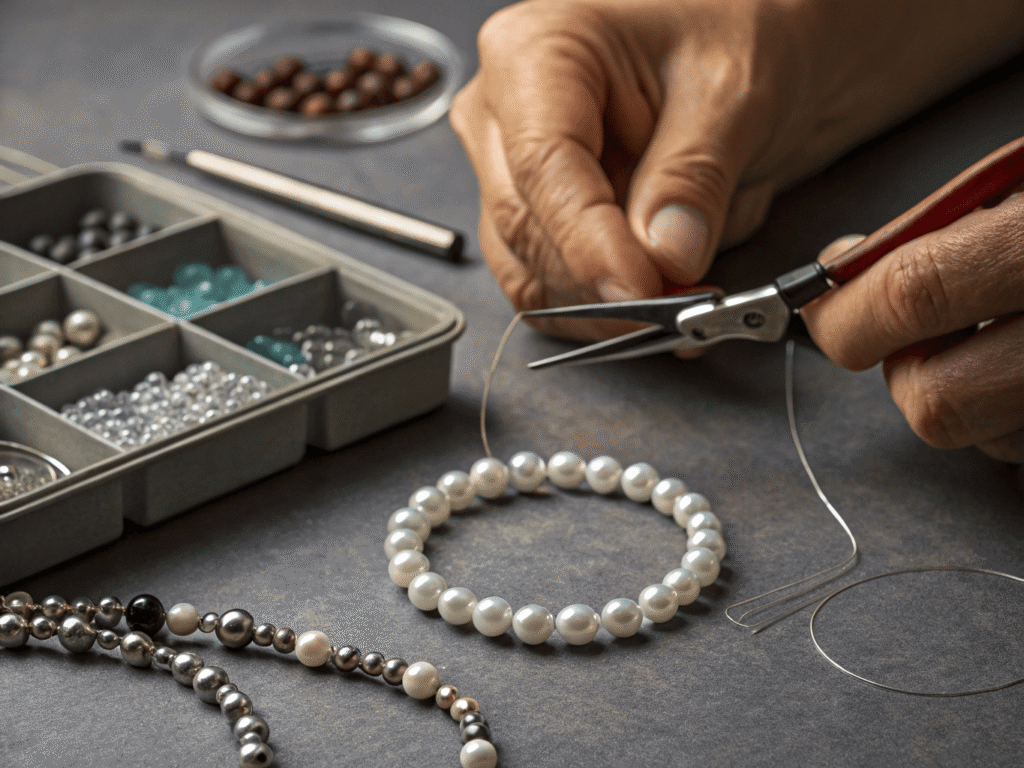
Designing the Necklace: Establishing the Visual Anchor
In coordinated sets, the necklace defines hierarchy—it’s the focal piece that informs proportion, pattern, and plating tone for the rest of the jewelry family. Professionals design necklaces first, using larger beads or pendants as the centerpiece and building symmetry outward.
Professional Workflow Example
- Place your main pendant or charm in the center of the wire or cable.
- Build outward with medium beads, then taper to smaller sizes near the clasp.
- Use a repetitive color formula (main color + highlight + metal tone) that the bracelet can later mirror.
This bilateral symmetry supports manufacturing scalability because automated assembly lines or hand-string stations can follow repeatable ratios.
Recommended Alloy & Plating Selection
| Metal Base | Cost Efficiency | Plating Options | Notes |
|---|---|---|---|
| Stainless Steel | High durability, low tarnish | IP Gold, IP Rose, PVD Silver | Ideal for global export; matches bracelet finish easily |
| Brass | Mid-range cost | E-coating, Flash Gold | Good for fashion lines with frequent seasonal updates |
| Alloy (Zinc or Copper) | Low-cost | Flash plating, color varnish | Limited plating thickness control—risk of color mismatch |
For stainless steel jewelry manufacturers, using IP plating (Ion Plating) ensures long-term color consistency between necklaces and bracelets, even across multiple production batches.
Designing the Bracelet: Translating Consistency in Miniature
The bracelet mirrors the necklace’s identity but adapts it for ergonomic comfort and scale. Smaller beads (3–6 mm) and concise metal accents work best.
Bracelet Design Rules
- Match plating tone: Gold necklace → gold jump rings, clasp, and spacers on bracelet.
- Repeat key elements: Reuse 2–3 bead types from the necklace in the bracelet.
- Simplify the pattern: Fewer beads, less length, but same design rhythm.
Craftsmanship Consideration for OEM Jewelry Sets
When producing coordinated bracelets at volume, hand assembly must maintain uniform pattern counts per strand. Automation can assist with this through bead feeder programming.
Quality Checkpoints (QC Table):
| Inspection Item | QC Method | Acceptable Variation | Standard (AQL) |
|---|---|---|---|
| Bead color tone match | Visual/Lab spectro | ±3% hue variation | Level II, 2.5 |
| Plating thickness | Micron measurement | ±0.005 microns | Level II, 1.5 |
| Assembly knot/loop tension | Pull test | Minimum 4 kgf | Level I, 4.0 |
| Charm alignment | Visual | Center variance <1mm | Level II, 2.5 |
Maintaining these parameters ensures that each bracelet set aligns with the necklace aesthetically and technically.
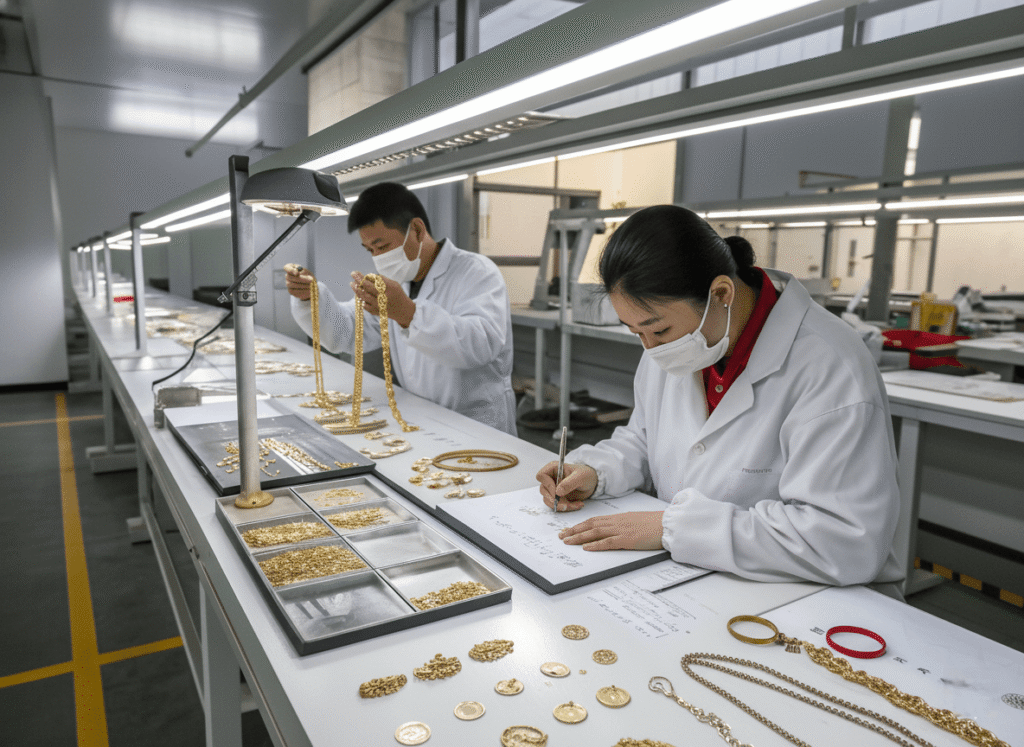
Maintaining Plating and Color Consistency
Across mass production, plating uniformity is one of the most vital, yet challenging, aspects of jewelry manufacturing. In matching sets, a single deviation in hue can visually separate two pieces meant to belong together.
Plating Techniques Overview
| Plating Type | Thickness Range | Durability | Ideal for |
|---|---|---|---|
| PVD/IP Plating | 0.03–0.1 microns | Excellent | Stainless steel jewelry |
| Electroplating | 0.02–0.05 microns | Good | Brass or alloy products |
| Flash plating | <0.02 microns | Fair | Fashion accessories or short-term wear |
Testing plating tone consistency with spectro-colorimeters prevents variance between batches. I often recommend using the same plating operator or vendor for both necklace and bracelet lines to avoid bath composition differences.
Color Consistency Standards
When dealing with beads, glass, or stones, use internal lot coding. Mixing two batches of aquamarine beads from different sources may result in color mismatch under daylight. Private label brands rely on the supplier’s color master sample for uniformity, stored digitally and physically for every new collection.
OEM vs DIY: Transitioning Your Design for Wholesale Production
For jewelry businesses evolving from DIY concepts to OEM/ODM scalability, process adaptation is critical. A design born from one kit can serve as a prototype for thousands of unit sets if engineered correctly.
OEM Production Transition Checklist
- Design Capture – Document bead sizes, pattern sequences, and metal finishes.
- Spec Sheet Creation – Turn design notes into clear BOM (Bill of Materials).
- Supplier Evaluation – Select manufacturers offering IP plating and MOQ flexibility.
- Prototype Lot Sampling – Order 3–5 pre-production sets before final mass run.
- QC & Packaging Standardization – Define bubble wrapping, bag sealing, and tag coding per SKU.
Supplier Evaluation Table
| Evaluation Factor | Recommended Standard | Relevance to Matching Sets |
|---|---|---|
| MOQ | 200–500 sets | Ensures plating consistency across production |
| Lead Time | 25–35 days | Allows full plating bath turnover |
| Material Range | SS304/316L, Brass, Copper | Enables compatible tone matching |
| Custom Finishes | IP gold, rose, silver | Supports brand color identity |
| Certification | Reach, Nickel-Free Guarantee | Essential for EU/US compliance |
As a jewelry exporter myself, I always encourage buyers to integrate modular kit design logic into their OEM design sessions—it keeps creative flexibility but adds industrial precision.
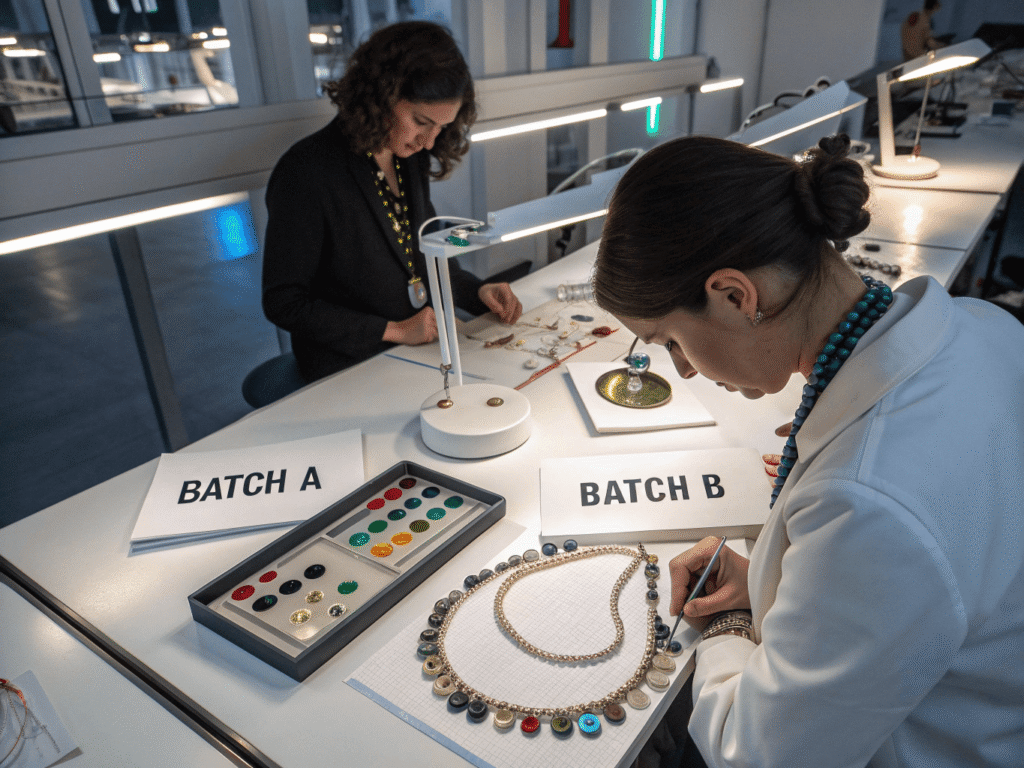
Supply Chain Optimization for Bulk Matching Sets
Production cost control begins with intelligent material allocation. In wholesale set manufacturing, matching pieces benefit from shared components, reducing procurement complexity and batch plating time.
Bulk Planning Strategy
- Combine necklace and bracelet plating runs to cut down per-piece plating cost.
- Standardize clasp styles across all sets to simplify sourcing.
- Consolidate bead purchases—buy shared color types in bulk for price breaks.
Example Cost Efficiency Table:
| Process | Individual Batch Cost | Combined Set Cost | Saving (%) |
|---|---|---|---|
| Plating | $0.45 per piece | $0.39 unified bath | 13% |
| Assembly | $0.30 per unit | $0.25 per set | 17% |
| QA & Packaging | $0.20 per item | $0.15 combined | 25% |
These savings scale rapidly with volume, enabling competitive export pricing while maintaining uniform visual coordination across the full line.
Trend Insights and Market Behavior
Jewelry buyers globally have shown increased demand for coordinated accessories sets—collections where pieces complement one another rather than match identically. This reflects a “harmonious diversity” trend, especially in markets like North America and Europe.
Current Market Behavior:
- Rising preference for sustainable stainless steel sets due to longevity.
- Growth in minimalistic harmonized designs (same metal color, subtle charm variations).
- OEM customers seeking flexible customization under unified plating batches.
For wholesalers, designing matching necklaces and bracelets from one kit or prototype accelerates time-to-market while meeting these style expectations.
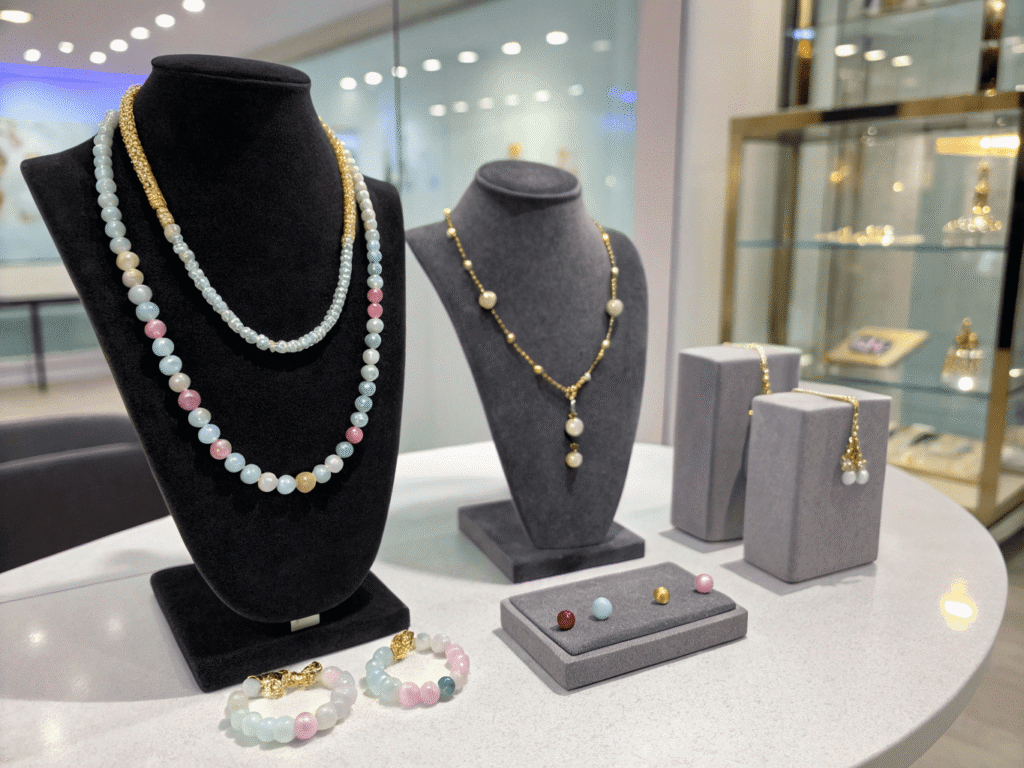
Conclusion
Designing matching necklaces and bracelets from one kit isn’t merely a creative exercise—it’s a scalable strategy for professional jewelry suppliers. By maintaining symmetry, proportional balance, and plating uniformity, you translate a single idea into mass-market-ready collections.
Key Sourcing Insights:
- Begin with cohesive kit-based prototypes.
- Standardize materials and plating processes for consistent visual output.
- Apply QC parameters to monitor color, finish, and structural integrity.
- Consolidate supply chain streams to optimize cost per unit.
Supplier Selection Tips:
- Choose vendors specializing in IP-plated stainless steel for durability.
- Verify plating thickness and color tolerance in lab reports.
- Request sample sets before bulk production to ensure aesthetic harmony.
As a custom jewelry supplier myself, I’ve seen how a small creative kit can inspire enduring product lines that perform globally. Ready to explore this concept further? Request sample sets, review our latest OEM catalog, or contact our specialized team for material consultation and pricing support.
