
As a manufacturer and global supplier specializing in silicone-based baby accessories and fashion jewelry components, I often receive the same question from sourcing managers and private label buyers: How safe are silicone beads for babies and toddlers? The answer lies in understanding the material science, certification landscape, and product design considerations that separate premium, compliant products from low-cost, high-risk imitations. For brands developing teething toys or baby-safe accessories, safety is more than a marketing point—it’s a legal and ethical responsibility.
Silicone beads designed for baby products are considered safe only if they are made from certified, BPA‑free food-grade silicone, meet EN 71 / FDA / CPSIA testing standards, and are assembled into designs that prevent choking and strangulation. Poor-quality, uncertified, or improperly sized beads present serious hazards. Procurement decisions should prioritize material certification, tensile strength testing, and transparency in supplier compliance documentation.
In this article, I’ll walk you through the safety framework used in baby silicone bead sourcing—from verifying BPA- and toxin-free materials to managing testing and compliance before shipment. As a long-term manufacturer serving OEM and private-label clients worldwide, I’ll share real industry insights on how to validate supplier quality, confirm testing requirements, and safeguard your brand reputation before launching silicone-based teething toys or accessories.
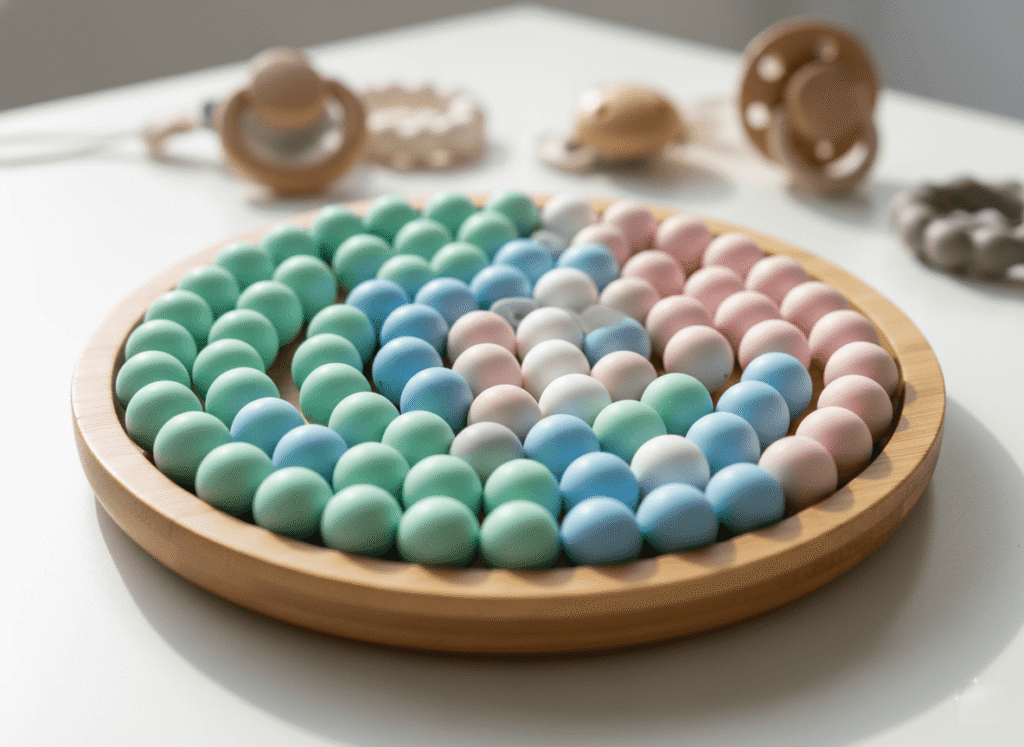
What Safety Certifications Should I Look for When Buying Silicone Beads for Baby Products?
When sourcing silicone beads for baby-related applications—especially teething toys, pacifier clips, or nursing necklaces—safety certification is the cornerstone of product compliance. Wholesale jewelry and baby product buyers should request documented proof from manufacturers to confirm that the silicone meets food-contact and toy safety regulations in their target markets.
Key Global Certifications to Verify
| Standard / Certification | Region / Scope | What It Covers | Verification Documents |
|---|---|---|---|
| EN 71 Parts 1–3 | Europe | Mechanical and chemical safety for toys | EN 71-1 (Mechanical), EN 71-2 (Flammability), EN 71-3 (Chemical) test reports |
| CPSIA | USA | Lead, phthalate limits, and labeling for children’s products | General Certificate of Conformity (GCC), test results from a CPSC-accredited lab |
| FDA Food Contact Compliance | USA | Determines suitability of silicone for direct contact with food or saliva | FDA 21 CFR 177.2600 declaration and lab reports |
| LFGB | Germany / EU | Food-level safety for elastomers and plastics | LFGB compliance testing report |
| ISO 8124 | Global | Similar to EN 71 but used broadly for international trade | ISO 8124 test certificate |
| CE / UKCA Marking | EU / UK | Compliance mark indicating conformity with essential safety regulations | CE / UKCA Declaration of Conformity |
Tip for Sourcing Managers: Always ask suppliers for the exact scope of testing. “EN 71 compliant” alone isn’t enough—request full test reports indicating which parts were evaluated (especially EN 71-3 for element migration).
OEM/ODM Considerations
If you are developing your own branded teething toy via OEM or ODM manufacturing, the responsibility for compliance often falls on your brand. You can work with your custom jewelry supplier or silicone manufacturer to conduct third-party testing prior to shipment. Established producers in China and Southeast Asia already have experience in organizing FDA and EN 71 testing with local accredited laboratories, which greatly simplifies the compliance process.
How Can I Ensure My Supplier Uses BPA-Free and Non-Toxic Materials?
A key determinant of safety is the quality and purity of raw silicone. Food-grade, platinum-cured silicone is the gold standard for teething accessories because it contains no fillers, heavy metals, or volatile compounds that can leach under heat or saliva exposure.
Material Verification Tactics
When working with a silicone bead manufacturer, these steps are essential:
- Request a raw material data sheet (RMS) or MSDS identifying the silicone’s compliance with food-contact regulations (FDA / LFGB).
- Ask if the silicone is platinum-cured rather than peroxide-cured; platinum curing yields cleaner and more stable polymer chains.
- Review the supplier’s internal BPA and heavy-metal test records.
- Confirm that all additives (especially color pigments) are certified for food-contact applications.
A reliable supplier will proactively share this data and may even show certificates from silicone material brands like Wacker or Dow Corning.
Common Contaminants in Low-Grade Silicone
| Contaminant | Source | Risk | How to Detect |
|---|---|---|---|
| BPA / Bisphenol Compounds | Used as plastic softeners | Endocrine disruption | Only detectable via chemical testing |
| Phthalates | Plasticizers used in cheaper silicone blends | Toxic to reproduction | Require formal test reports |
| Lead / Cadmium | Pigments in non-food-grade coloring agents | Heavy-metal poisoning | EN 71-3 chemical migration test |
| Fillers or chalk powder | Used to reduce cost | Cracking or poor elasticity | Whitish residue, chalky feel, or brittleness |
Buyer’s Best Practices
- Avoid suppliers that cannot produce a full test report or only provide a “self-declaration.”
- Request samples and perform smell and visual checks before mass production; pure silicone should be odorless, smooth, and flexible.
- Consider implementing batch testing during production to verify ongoing compliance.
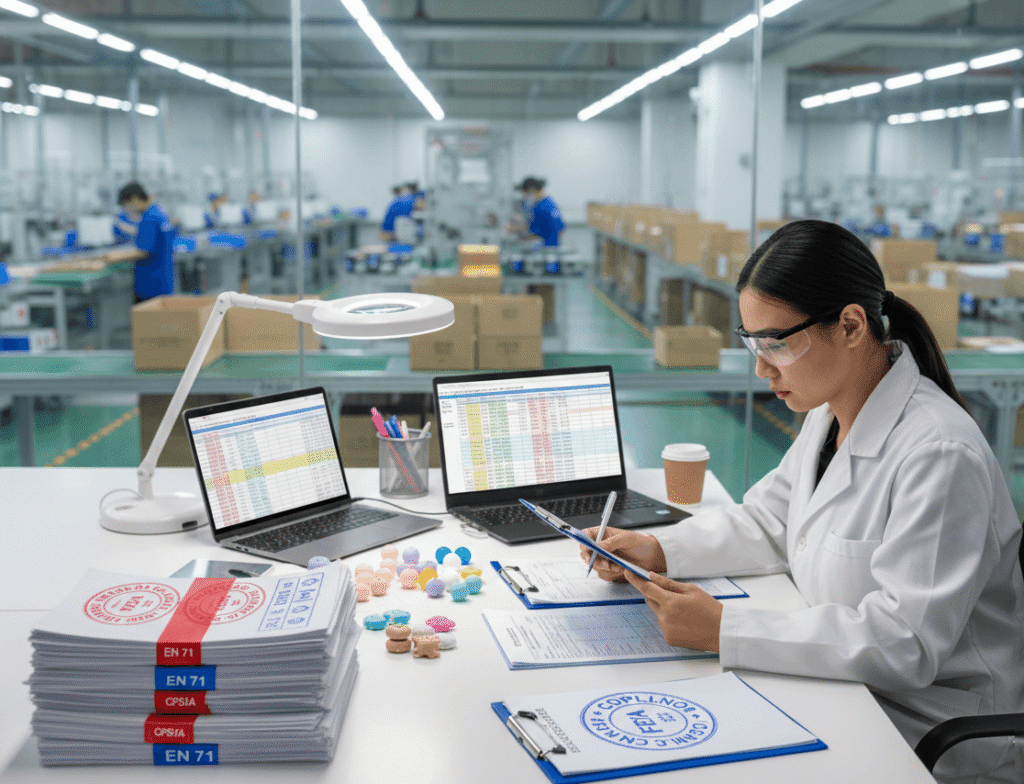
What Testing Requirements Apply to Silicone Beads Used in Teething Toys?
Mechanical and Physical Safety Tests
Each jurisdiction defines minimum standards for mechanical durability to prevent choking, tearing, or detachment of parts. Before export, a qualified laboratory should run the following checks:
| Test Type | Test Description | Purpose |
|---|---|---|
| Tensile Strength / Pull Test | Measures the force needed to pull beads off the cord or break attachments | Ensures no bead detaches under baby’s chewing and pulling force |
| Small Parts Test | Simulates if any bead can fit in the choking‑hazard cylinder | Confirms safety for children under 36 months |
| Drop Test | Drops the product from various heights to detect dislodgement | Prevents parts from detaching upon impact |
| Torque and Tension Tests (ASTM F963) | Twisting/force to simulate rough use | Detects weak joints or clasps |
Chemical Composition Tests
The chemical safety of silicone beads depends on composition and pigment stability. Required assessments include:
- EN 71‑3: Migration of elements (lead, antimony, cadmium, etc.)
- Phthalate testing per CPSIA / ASTM F963
- BPA content test to ensure compliance with 0.01 mg/L or lower thresholds
- Volatile Organic Compound (VOC) detection for odor and off-gassing limits
Microbiological and Heat Safety
Silicone beads are naturally resistant to bacterial growth, but microbiological testing and sterilization stability are still necessary for teething products.
- Verify that beads can withstand steam sterilization up to 100°C–120°C.
- Test for microbial growth inhibition after repeated sanitation cycles.
- Ensure the product remains dimensionally stable and colorfast post-sterilization.
Many brands now include a “boil test” where the finished teether is submerged in boiling water for 5 minutes and checked for deformation—an effective low-cost QC method before shipping.
How Can I Verify Compliance with FDA or EN71 Standards Before Import?
Ensuring regulatory compliance before importation is critical for brand reputation and customs clearance. As a wholesale or private-label buyer, there are structured ways to ensure the safety integrity of silicone bead products before they reach the market.
Request Documentation Package
Ask the supplier to provide:
Material Declaration & Traceability Sheet
- Identify ingredient suppliers and curing agents.
- Include silicone material batch number and certification origin.
Laboratory Test Reports
- Issued by accredited third-party labs (e.g., SGS, Intertek, Bureau Veritas, TUV).
- Explicitly list item photos, test standards (EN 71-3, FDA CFR 177.2600, CPSIA), and results (“Pass/Fail”).
Production Certificate or ISO Documentation
- Check for ISO 9001 (Quality Management System) and ISO 14001 (Environmental Management).
Declaration of Conformity (DoC)
- Required for EU imports to justify CE marking.
- Signed by the legal manufacturer or importer.
Conduct an On-Site or Third-Party Audit
Before finalizing shipments:
- Commission a Pre-Shipment Inspection (PSI) to verify labeling, batch testing, and packaging safety.
- Employ specialized QC services to pull random samples and perform rapid silicone tests.
Understand Regulatory Differences
| Region | Key Regulation | Unique Requirement |
|---|---|---|
| USA | CPSIA / ASTM F963 / FDA | Lead < 100 ppm, BPA free, durable labeling |
| EU | EN 71 Parts 1–3, REACH | Migration limits for specific elements |
| Australia / NZ | AS/NZS ISO 8124 | Similar to EN 71, mandatory for baby toys |
| Canada | CCPSA (Canadian Consumer Product Safety Act) | Hazardous substances & choking hazard warnings |
Labeling and Documentation for Customs
Proper labeling not only streamlines customs clearance but also reinforces buyer confidence:
- Clearly print age grade (“0+” or “for babies 3 months and up”).
- List material composition (100% Food‑Grade Silicone).
- Include manufacturer or importer details and batch code.
- Attach relevant mark (CE, UKCA, ASTM compliant) only after legitimate testing.
Additional Section: Supplier Evaluation Framework for Silicone Beads
If your company sources from multiple fashion jewelry or silicone accessory manufacturers, implementing a scoring matrix ensures consistent quality decisions.
| Evaluation Criteria | Weight (%) | Description | Score |
|---|---|---|---|
| Raw Material Transparency | 25 | Supplier provides full composition, test certificates, and traceable lot numbers | (1–10) |
| Laboratory Certifications | 20 | Independent EN 71 / FDA test reports from qualified labs | (1–10) |
| Production Quality Control (QC) | 20 | In-house QC records, tensile test data, sterilization results | (1–10) |
| OEM/ODM Capabilities | 15 | Ability to design custom moldings, private label packaging, and compliant testing | (1–10) |
| Pricing vs Compliance Ratio | 10 | Transparent material costs with no quality shortcuts | (1–10) |
| Communication and Responsiveness | 10 | Clear reporting, timely document updates, after-sales support | (1–10) |
A cumulative score above 85% typically indicates a supplier ready for long-term cooperation and private-label expansion.
Summary of Key Sourcing Insights
- Safety depends on certification and supplier integrity—not on “silicone” alone. True food-grade, BPA-free silicone is inert and safe, but low-cost uncertified materials pose hidden hazards.
- Verify certifications such as EN 71, CPSIA, FDA 21 CFR 177.2600, and insist on third-party test reports.
- Choking and strangulation prevention is just as vital as chemical safety—bead size, cord tension, and clasp design all matter.
- Regular batch testing ensures ongoing compliance and protects your brand reputation in export markets.
- Partner only with suppliers experienced in OEM/ODM baby accessory production, not general fashion jewelry vendors without compliance background.
Conclusion: Build Safety Confidence Into Every Bead
From my experience serving global distributors and private-label brands, the brands that thrive in the baby accessories sector share one common strategy—they build safety confidence into their supply chain. That means purchasing only from verified silicone bead manufacturers who can supply authentic, traceable, and fully tested materials.
When these standards are met, silicone beads can be an excellent choice for teething and sensory toys, offering durability, cleanliness, and design flexibility unmatched by most materials. But without testing and certification, even the most visually appealing beads can compromise brand trust and child safety.
If your team is evaluating new silicone bead suppliers or preparing to launch a baby product line, consider requesting sample kits, FDA/EN 71 test dossiers, and personalized OEM design support. Our team has helped numerous international brands streamline compliance and production—let’s make sure your next batch is as safe as it is stylish.
