
Many educators and parents wonder whether fuse beads — those tiny, colorful plastic beads used to make picture designs — can do more than simply entertain children. Can they actually teach something valuable, like color recognition and visual perception? The answer is a confident yes.
Fuse beads are powerful tools for strengthening children’s ability to identify, compare, and memorize colors. Through activities like color sorting, pattern creation, and template-based design, these beads transform simple craft play into a multisensory learning experience that supports cognitive growth and visual discrimination.
Understanding how and why fuse beads work so effectively can help teachers, parents, and therapists design better activities for developing early color recognition and visual-motor skills.
How Can I Design Activities to Teach Color Theory with Fuse Beads?
Designing color-based activities around fuse beads is straightforward and flexible. The goal is to give learners repetitive, enjoyable exposure to different colors and relationships among them.
Color Sorting and Naming Games
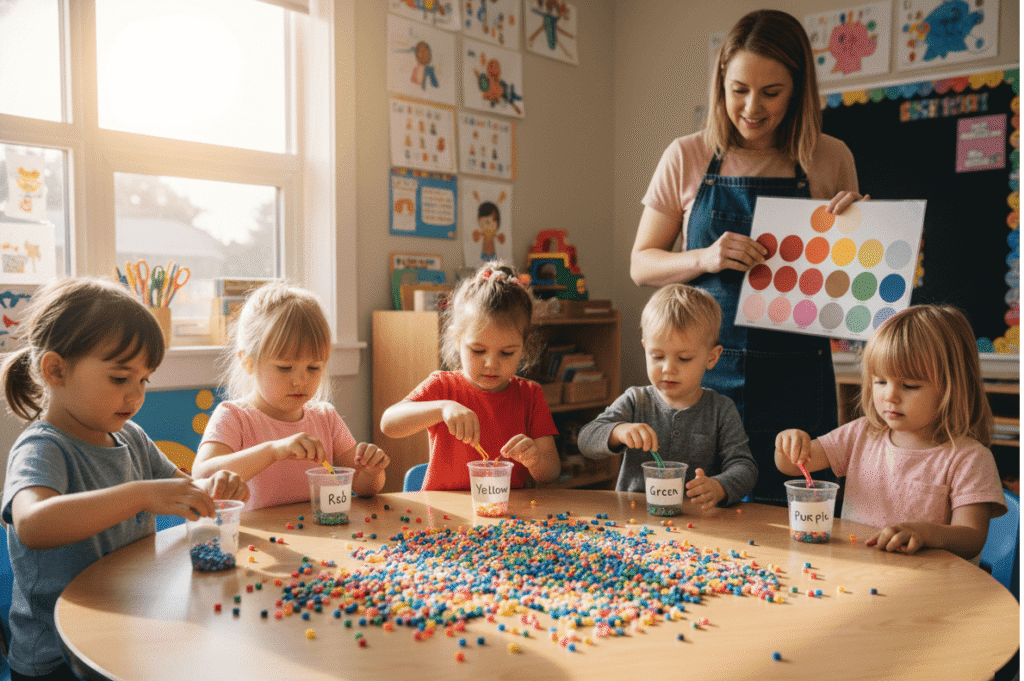
- Provide a mixed batch of beads and small containers or trays.
- Ask children to sort them by color and name each one as they work.
- For older children, include shades and tints (light blue, navy, turquoise) to sharpen their hue distinction.
Color Wheel and Gradient Designs
- Encourage students to assemble a mini color wheel using primary and secondary colors.
- Later, expand to gradients or “ombre” patterns, where beads gradually shift from light to dark.
- This reinforces understanding of color relationships and contrast—two pillars of color theory.
Create Art That Mimics Real-World Objects
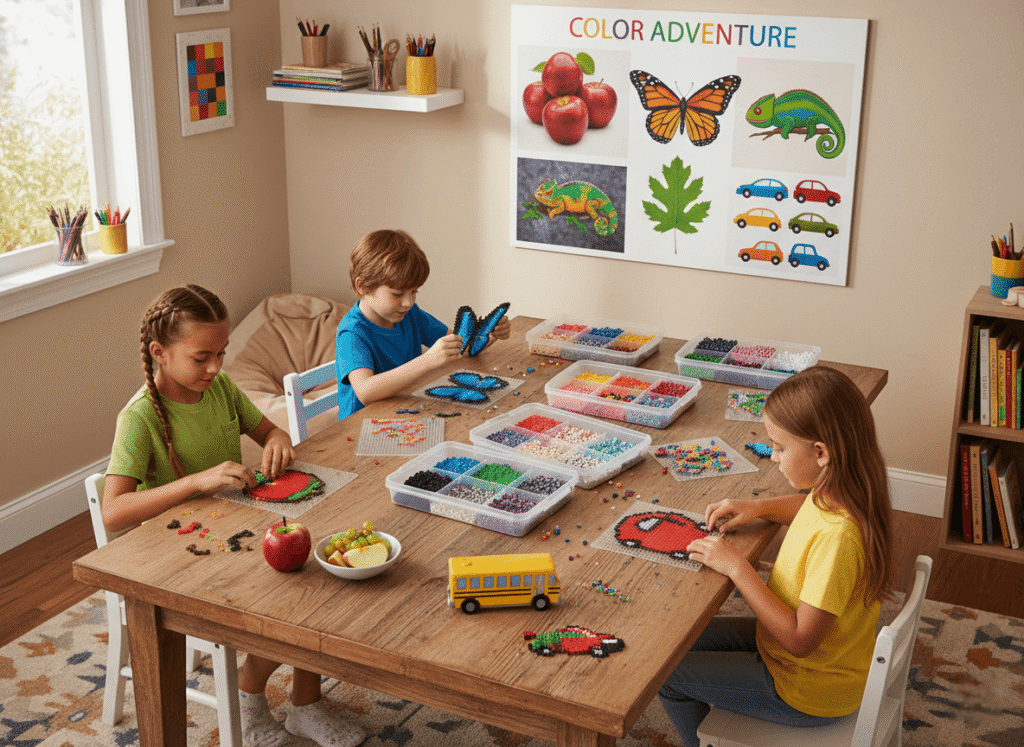
- Ask children to replicate common objects (fruits, vehicles, animals) in realistic colors.
- Discuss color choices (“Why did you use this green for the apple’s leaf?”).
- These conversations help solidify color-object associations.
Experiment with Color Mixing Concepts
- Although fuse beads don’t physically mix pigments, you can simulate color blending by alternating or layering bead colors next to each other, e.g., red–yellow to imply orange.
- Use this to introduce concepts like warm/cool colors and analogous schemes.
What Methods Can I Use to Assess Children’s Color Discrimination Progress?
Evaluation doesn’t need to feel like a test. Observation and creative participation often reveal far more about how a child perceives color.
Observation Techniques
- Sorting Speed and Accuracy: How quickly and accurately can a child separate similar colors (e.g., pink vs. coral)?
- Pattern Reproduction: Ask the child to copy a simple, two-color pattern. Then increase complexity with multiple shades.
- Verbal Identification: Encourage them to verbally name colors while working. Listen for vocabulary expansion and precision (“light purple” instead of simply “purple”).
Practical Assessment Tools
| Method | Focus Skill | How to Apply |
|---|---|---|
| Bead Sorting Race | Quick visual discrimination | Mix 5–6 hues; time how long it takes to separate |
| Color Match Cards | Hue identification | Provide template cards; match beads to printed colors |
| Gradient Reproduction | Tonal awareness | Ask students to arrange from lightest to darkest tone |
| Collaborative Art Project | Verbal and social color use | Small groups describe and select colors together |
Monitoring these tasks over time helps track improvement in speed, accuracy, vocabulary, and tonal sensitivity—key markers of color recognition growth.
How Do Repetitive Bead Patterns Enhance Visual Learning?
Repetition is crucial for visual learning because it builds familiarity and cognitive connection between visual stimuli and memory storage.
Reinforcement Through Routine
Each time a child organizes, selects, and places beads, the brain reinforces stored color information. Over multiple sessions, they begin recognizing hues instantly without conscious analysis.
Pattern Familiarity and Predictive Learning
Working on bead templates or pixel-style images helps children recognize consistency and variance within visual patterns. Even small errors (using dark blue instead of navy) train the brain to notice differences.
Fine Motor and Visual Coordination
Because each bead must be precisely placed, repetitive bead use demands hand-eye coordination that integrates tactile and visual systems—two sensory channels essential to deep color learning.
Why Are Fuse Beads Effective for Strengthening Sensory and Visual Memory?
Fuse beads engage multiple senses simultaneously, making learning stickier and more concrete.
Multisensory Integration
- Children see, touch, and sometimes even hear beads as they pour and sort them.
- The combination of visual (color), tactile (texture), and kinesthetic (movement) cues helps anchor memory traces in multiple parts of the brain.
Visual-Spatial Awareness
- Bead art requires planning color placement within a fixed grid.
- This strengthens spatial mapping skills—understanding where each color fits relative to others.
Color Naming and Association Strengthening
- Repetitive verbal labeling of colors while placing them boosts both sensory and linguistic memory.
- Such naming integrates language learning with color perception, aiding retention and recognition.
Emotional and Social Reinforcement
- Group projects let children discuss and negotiate color choices, amplifying memory through shared experiences.
- Positive emotional context enhances retention; children remember colors they associate with fun and accomplishment.
Conclusion
Fuse beads are far more than just colorful craft materials—they are engaging educational tools that sharpen children’s perceptual, cognitive, and motor abilities.
Through deliberate use of color sorting, pattern replication, and template-based tasks, educators can:
- Reinforce color recognition and vocabulary
- Strengthen visual discrimination and fine motor coordination
- Support sensory integration and visual memory
For parents, teachers, and occupational therapists, fuse bead activities provide a cost-effective, tactile, and research-supported approach to early color learning. Regularly incorporating these exercises can lead to measurable improvement in a child’s ability to see, describe, and work confidently with color.
