
In classrooms and enrichment labs around the world, fuse beads (commonly known as Perler beads or melty beads) have emerged as versatile tools that go far beyond arts and crafts. Educators increasingly recognize their value in developing crucial foundational skills in early childhood and primary education—ranging from color recognition and pattern creation to problem-solving and mathematical thinking. For teachers, child development specialists, and curriculum coordinators, fuse beads present a unique, low-cost, and high-impact way to link creativity with structured learning outcomes.
Fuse beads are hands-on teaching materials that build fine motor coordination, reinforce patterns and symmetry understanding, and embed STEM concepts such as pixel-based graphing, coding logic, and design sequencing. They work well across subjects—art, math, science, and technology—and adapt to individual and group learning contexts alike.
At their core, fuse bead projects help students transition seamlessly from playful creativity to analytical reasoning. As children plan bead placements on pegboards, they develop sequencing skills, spatial awareness, and problem-solving strategies that mirror real-world cognitive processes. From early years exploration to upper-grade project-based learning, integrating fuse beads into classroom activities empowers teachers to meet educational goals while keeping engagement high. They also fit perfectly within modern makerspace pedagogy, emphasizing tactile learning through creation, discovery, and collaboration.

How Can I Integrate Fuse Beads into Creative Classroom Activities?
Encouraging Cross-Disciplinary Creativity
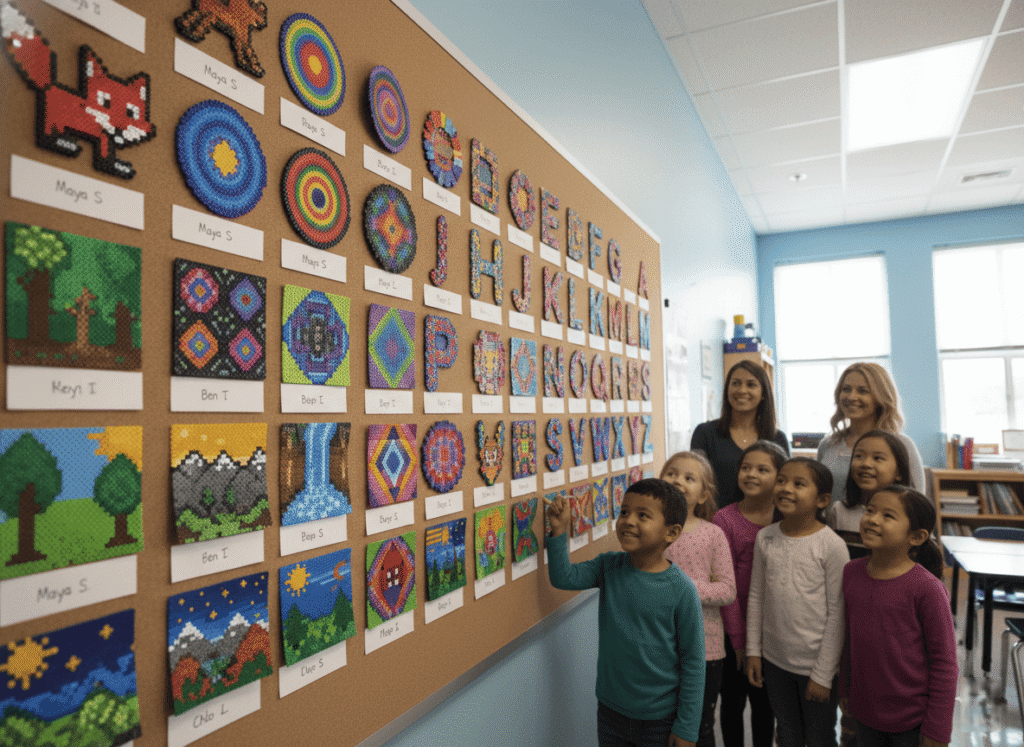
As an educator, I’ve seen fuse beads transform static lessons into dynamic, multi-sensory experiences. They can be used as a standalone art project or blended into science, math, and literature curricula. For example:
- Math Integration: Students can design symmetrical shapes to understand geometry, symmetry, and measurement.
- Art Connection: Learners explore color mixing, patterns, and gradients to understand color theory.
- STEM Projects: Fuse beads replicate the concept of pixels, allowing digital-to-physical translation of images or coding patterns.
- Language Arts: Students can build story characters or settings using bead mosaics, then narrate their creative process.
Project-Based Examples
| Activity Type | Subject Link | Skill Developed | Description |
|---|---|---|---|
| Pattern Designs on Pegboards | Mathematics | Pattern recognition & counting | Students follow or create sequences by color or shape. |
| Pixel Art Replication | Technology | Coding logic & spatial mapping | Convert digital sprites or icons into bead mosaics. |
| Heat Fusion Experiment | Science | Understanding material change | Observe heat transformation as plastic fuses. |
| Character Creation | Language Arts | Storytelling & description | Design characters, then write short stories about them. |
Makerspace and Group Projects
Fuse beads are ideal for collaborative learning stations. In group settings, teams negotiate designs, assign roles (designer, organizer, fuser), and solve aesthetic or structural problems collaboratively. This fosters communication, critical thinking, and planning, aligning perfectly with 21st-century learning standards.
Tip for educators: Keep color sets pre-sorted and use clear storage bins to increase accessibility and classroom efficiency. Create rotating activity centers so groups can tackle different bead-based challenges.

What Learning Outcomes Can I Expect from Using Fuse Beads with Students?
When integrated intentionally, fuse bead activities yield measurable academic, motor, and cognitive outcomes that align with standard educational objectives across early and middle-childhood classrooms.
Fine Motor and Sensory Development
Placing small beads precisely on pegboards develops pincer grasp, bilateral coordination, and hand-eye control—skills fundamental for handwriting and tool manipulation. Occupational therapists often use these projects to improve dexterity and tactile awareness in both general and special education contexts.
Mathematical Reasoning and Spatial Awareness
Incorporating counting and spatial arrangement exercises allows teachers to assess number sense and geometry comprehension. Students can:
- Count total beads or calculate area and perimeter.
- Identify symmetry in their designs.
- Explore spatial distribution and measurement with grid patterns.
This tactile approach builds numeracy while reinforcing logical reasoning.
Cognitive and Sequencing Skills
Designing with fuse beads requires planning ahead—students must visualize their final pattern, select colors, and follow a specific placement sequence. This type of executive function practice strengthens memory retention and task management.
| Skill Area | Cognitive Outcome | Example Classroom Task |
|---|---|---|
| Pattern Recognition | Visual logic & recall | Recreate a model design using color-coded cues. |
| Sequencing | Planning and foresight | Students follow multi-step instructions to complete artwork. |
| Focus and Patience | Sustained attention | Large or complex designs requiring extended engagement. |
Emotional Regulation and Mindfulness
The repetitive, rhythmic nature of placing each bead encourages calm focus and mindfulness. Teachers often use fuse bead activities as transitional or cool-down exercises to help students reset attention between high-energy lessons. Creating a finished product also heightens self-efficacy and pride, reinforcing positive self-concept through achievement.
How Do Fuse Bead Projects Align with Early Childhood Education Goals?
Early childhood frameworks emphasize experiential learning, sensory integration, and motor development—all areas where fuse beads shine.
Developmentally Appropriate Practice
For preschool and kindergarten-age learners, placing beads supports fine motor milestones (ages 3–5). Simple pattern designs are ideal for introducing visual sequencing and spatial orientation. Sorting beads by color or size further enhances classification and early math reasoning.

STEAM Learning Integration
By combining Science, Technology, Engineering, Art, and Mathematics, teachers can use fuse beads to unify subjects:
- In science, observe changes in matter when heat fuses plastic.
- In art, explore patterns, shape, and texture.
- In technology, mimic pixel patterns to demonstrate how digital images are constructed.
- In math, apply grids, coordinates, and pattern replication.
This convergence mirrors modern education’s interdisciplinary approach, nurturing curiosity and analytical thinking simultaneously.
Social-Emotional and Collaborative Development
Collaborative designs teach turn-taking, negotiation, and empathy as children build while respecting shared creative space. Group projects also enhance listening and communication, laying a foundation for cooperative learning habits in later school years.
Why Do Educators Choose Fuse Beads for Hands-On Learning?
Tactile and Visual Engagement
Fuse beads bring abstract ideas into tangible form. Concepts like patterns, symmetry, measurement, and color theory become instantly interactive. Their affordability and simplicity make them a practical teaching tool for diverse learning environments—from preschool classrooms to high school makerspaces.
Inclusion and Accessibility
Fuse bead projects are inclusive for students with different learning abilities. In special education, they strengthen tactile feedback and enhance concentration. For gifted learners, they offer complexity through advanced pattern engineering or coding integrations.
Coding and Digital Translation
Modern educators frequently link fuse beads with introductory coding. By designing on a pixel grid, students can translate visual patterns into coordinate-based instructions—creating a bridge between creativity and computational logic. A bead design may translate directly into grid coordinates (x, y) similar to sprites in programming environments like Scratch.
Sustainable and Scalable Classroom Use
Fuse beads are reusable before fusing, making them sustainable for experimentation. Bulk storage simplifies classroom management, while heating stations can be safely operated by teachers or designated aides. Multi-grade application—from preschool color sorting to secondary-level design patterning—means educators maximize value from one versatile material.
Practical Advantages for Teachers:
- Minimal mess; easy to set up and clean.
- Affordable bulk purchase costs.
- Compatible with multiple learning frameworks (Montessori, Reggio Emilia, STEM/STEAM).
- Supports both independent and group-focused pedagogy.
Example: Cost vs Benefit Comparison
| Criteria | Traditional Art Materials | Fuse Beads |
|---|---|---|
| Motor Skills Training | Moderate | High |
| Cross-Subject Adaptability | Medium | High |
| Cost per Student (Reusable) | Higher | Lower |
| Cognitive Engagement Time | Short to Medium | Long |
| Suitability for Group Work | Moderate | Excellent |
Extending Fuse Beads into Curriculum Innovation
Digital-to-Physical Applications
Linking fuse beads to pixel mapping, symmetry plotting, or coding coordinates provides a new form of kinesthetic coding. Students grasp how digital assets (like icons or emojis) relate to real-world object dimensions.
Early Engineering and Design Thinking
Fuse bead grids encourage young learners to think like engineers:
- Define a problem (design a specific image).
- Plan the layout.
- Execute systematically.
- Evaluate results and iterate on design.
This structured, design-based learning supports concrete understanding of algorithmic thinking embedded in engineering and programming foundations.
Classroom Management & Quality Control
Educators often introduce simple QC (quality control) discussions—students inspect designs for uniformity, symmetry, or misplaced beads before fusing. This peer-review method introduces early responsibility for precision and accuracy, mirroring scientific procedure.
Conclusion
Fuse beads offer much more than a creative pastime; they’re an educational powerhouse wrapped in simple, colorful form. Teachers who integrate them strategically unlock a spectrum of learning opportunities—from fine motor skill development and mathematical logic to emotional regulation and collaborative design thinking.
By aligning with STEM and early childhood education goals, fuse bead activities give tangible meaning to abstract ideas, promoting focus, patience, and teamwork along the way. Whether in a preschool class learning patterns or a middle school coding workshop connecting pixels to physical art, fuse beads exemplify accessible innovation in action.
Educators seeking inexpensive, durable, and outcome-driven classroom materials will find fuse beads an enduring ally. Explore new ways to adapt them—link projects to coding, geometry, or storytelling—and watch your classroom transform into a place where creativity meets structured learning every day.
