
Industry teams often tell me the same story: the design is ready, demand looks promising, but finding a factory that can translate sketches into consistent, scalable, and profitable jewelry is the biggest bottleneck. It’s not just about price—materials, plating durability, stone-setting quality, and lead-time reliability decide whether a product line wins or stalls.
Here’s the short answer: evaluate factories with a structured scorecard across capability, quality control, communication, compliance, and scalability—then verify with samples, small pilot runs, and third-party checks. Start from your product’s technical requirements (materials, plating specs, stone setting, tolerances), select 3–5 shortlisted manufacturers, and stress-test their processes before committing volume.
Whether you’re a consumer-facing brand or a B2B wholesaler, choosing the right partner impacts returns rate, brand reputation, and cash flow. For designers and OEM partners, it’s the difference between repeatable success and product recalls. Below, I’ll share a practical, step-by-step approach I use when matching brands with factories for custom and private label fashion jewelry, including gold-plated brass, stainless-steel collections, and cubic zirconia (CZ) lines.
Define Your Technical Requirements Before You Search
Factories don’t fail because they’re “bad”—they fail when your requirements don’t match their core strengths. Start with a clear technical brief.
Build a Product Tech Pack (Non-Negotiable)
Include:
- Design files: sketches, 3D models (STL/STEP), and clear dimensions/tolerances.
- Materials: brass, 304/316L stainless steel, sterling silver, zinc alloy; specify lead- and nickel-free if required.
- Plating: micron thickness (e.g., 0.5–1.0 µm Au over palladium/nickel barrier), vacuum PVD vs. electroplating; expected wear hours.
- Stones: CZ grade, synthetic gems, pearls; setting types (pavé, prong, bezel); stone sizes.
- Finish: high polish, satin, matte, textured, e-coating for tarnish resistance.
- Hardware: findings, clasps, chains (cable, figaro, rope) and strength specs.
- Compliance: REACH, RoHS, Prop 65, CPSIA for children’s items, nickel release per EN 1811.
- Packaging: anti-tarnish, polybags, carding, barcode/label formats.
- Volume: MOQ per SKU, per color/size; seasonal forecast.
- QA standards: AQL levels, dimensional tolerance, plating test expectations (salt spray, abrasion, sweat test).
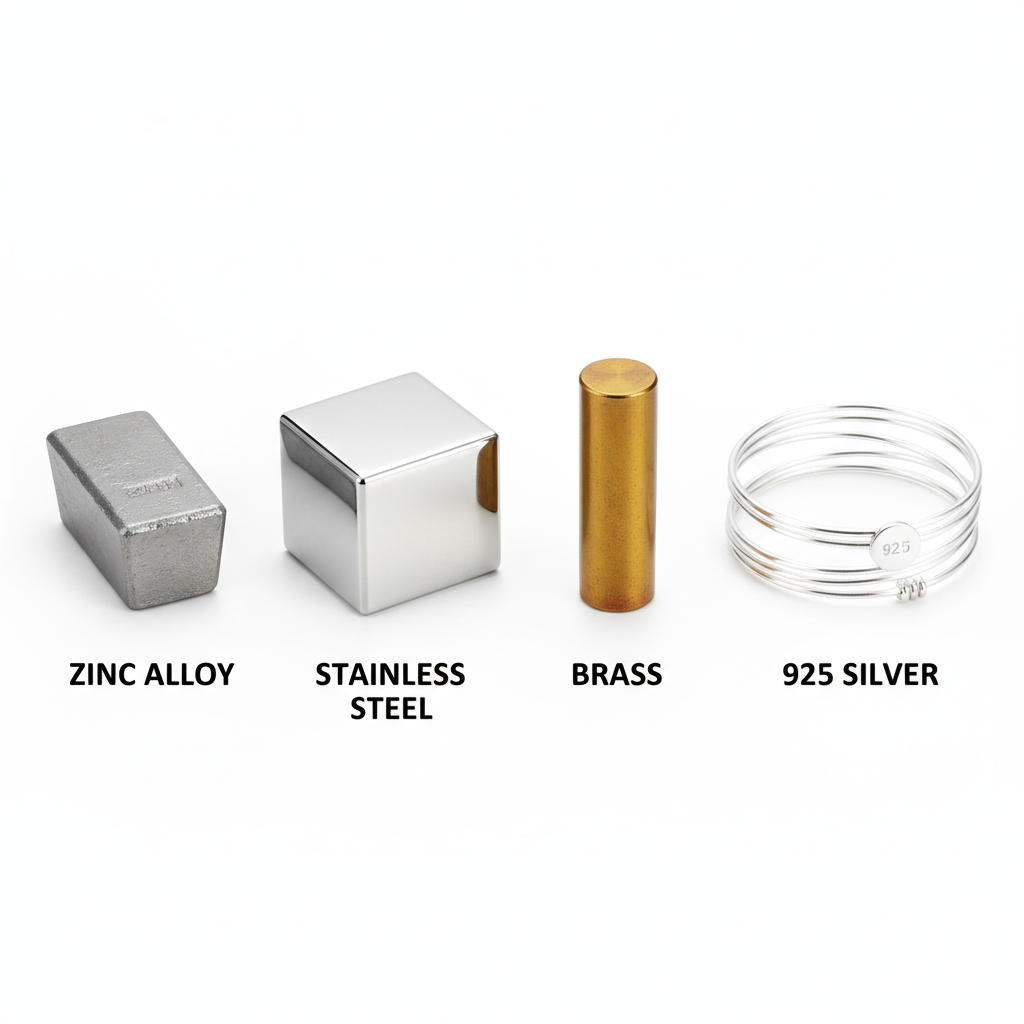
Match Materials to Factory Strengths
- Brass + heavy electroplating: ideal for fashion jewelry with strong gold-look and stone setting.
- 316L stainless steel + PVD: best for hypoallergenic, water-proof claims; lower tarnish risk; crisper laser engravings.
- Sterling silver: great for fine-detail casting, but plating wear differs; confirm anti-tarnish steps.
- Zinc alloy: use only for statement pieces with complex shapes at low cost; avoid in sensitive markets due to durability/perceived value.
Common Mistakes and Fixes
- Mistake: “Gold color” without micron spec. Fix: define plating system (e.g., 0.3 µm Au, 0.8 µm total, e-coat top).
- Mistake: No stone-setting spec. Fix: define setting method and pull-test requirement.
- Mistake: Ignoring nickel release. Fix: require EN 1811 test before mass production.

Build a Shortlist and Score Them Objectively
Use multiple sourcing channels, then score with a standardized matrix.
Where to Source
- Trade shows: Hong Kong Jewellery & Gem Fair, JGW, Vicenzaoro, Istanbul Jewelry Show, Shenzhen Jewellery Fair—best for face-to-face vetting.
- B2B platforms: Alibaba, Global Sources, IndiaMART—filter by “OEM/ODM,” “micron plating,” “316L PVD,” “nickel-free.”
- Referrals: Ask non-competing brands or consultants; review packaging suppliers’ networks.
- Social proof: Instagram/LinkedIn factory pages show recent capabilities and finishes.
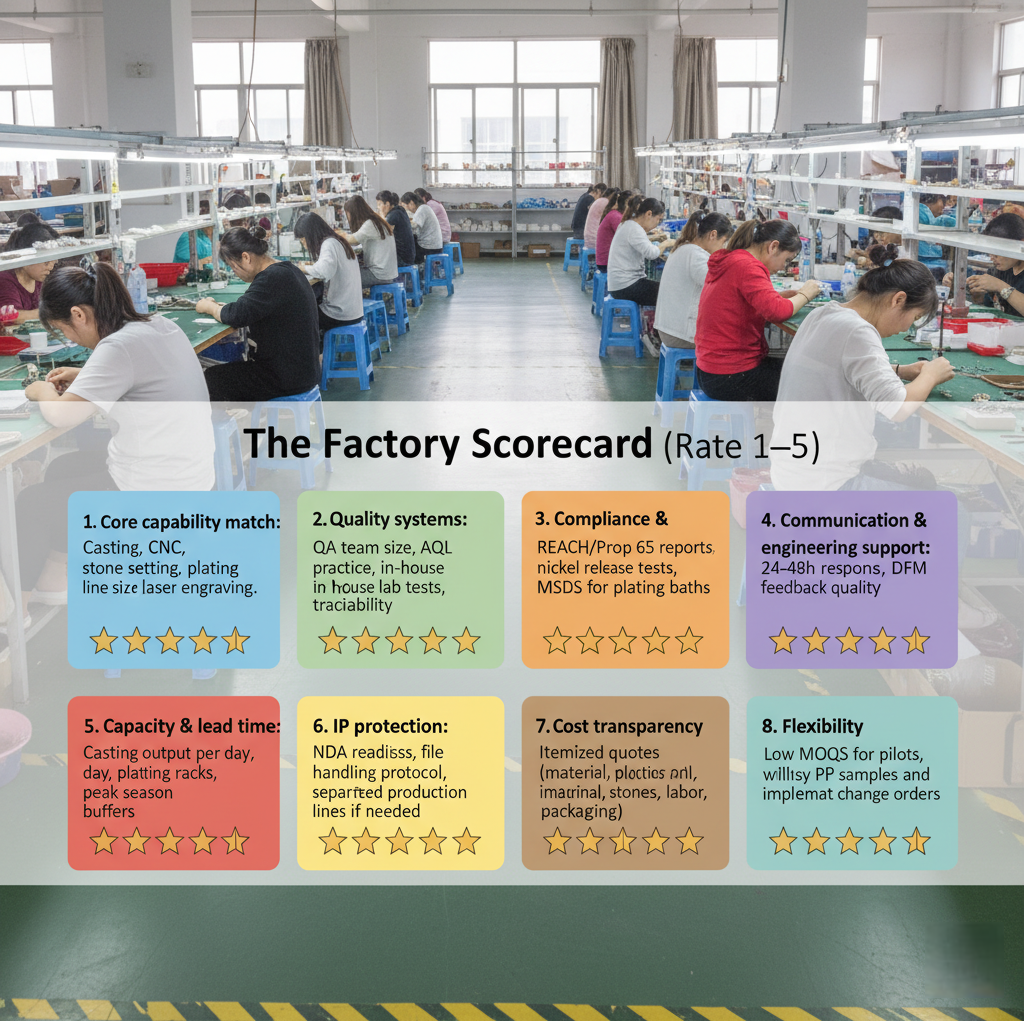
The Factory Scorecard (Rate 1–5)
- Core capability match: Casting, CNC, stone setting, plating line size, laser engraving.
- Quality systems: QA team size, AQL practice, in-house lab tests, traceability.
- Compliance & documentation: REACH/Prop 65 reports, nickel release tests, MSDS for plating baths.
- Communication & engineering support: 24–48h response, DFM feedback quality.
- Capacity & lead time: Casting output per day, plating racks, peak season buffers.
- IP protection: NDA readiness, file handling protocol, separated production lines if needed.
- Cost transparency: Itemized quotes (material, plating, stones, labor, packaging).
- Flexibility: Low MOQs for pilots, willingness to run PP samples and implement change orders.
Red Flags
- Only “photo catalog sales,” minimal engineering talk.
- Refusal to specify plating thickness or stone grade.
- No AQL or test data; vague on compliance.
- Overpromising lead times that seem unrealistic for your process.
Validate with Samples, Pilots, and Data
Move from quotes to proof. This is where good factories differentiate themselves.
Sampling Flow
- DFM review: Ask for manufacturability feedback—gate thickness, prong shape, chain tensile strength.
- 3D prototype: Resin/metal sample to verify scale and ergonomics.
- Pre-production (PP) sample: Fully finished piece with final plating and stones for approval.
- Golden sample: Sealed, signed sample used as the QC reference.
Tests to Require (By Product Type)
- Plating durability: Abrasion cycles, artificial sweat test (ISO 3160-2), salt spray for PVD steel.
- Adhesion: Tape test on plating edges, bend test on ear wires.
- Stone security: Pull test (e.g., 2–5 N depending on stone size).
- Nickel release: EN 1811 for EU compliance; lead, cadmium limits per EU/US rules.
- Color consistency: Delta E checks, visual under D65 light box.
Pilot Run Before Mass Production
- Run 50–200 pcs across SKUs to measure yield, defect types, and cycle times.
- Track issues: pinholes in plating, misalignment of prongs, chain breakage rates.
- Implement corrective actions, then lock the process traveler and QC checklist.
Costing, Lead Times, and Risk Control
A factory is “suitable” when it balances quality, cost, and reliability over multiple seasons—not just the first PO.
Typical Lead Times (Guideline)
- Design + DFM: 3–7 days
- Sampling: 10–20 days (casting + plating queues can extend this)
- Mass production: 25–45 days depending on SKU count, plating colors, and stones
- Peak season buffers: +10–20 days around Q3–Q4
Cost Drivers You Must Model
- Material: brass vs. 316L vs. 925 silver; silver price volatility.
- Plating system: thicker micron gold, palladium barrier, or PVD adds cost but reduces returns.
- Stone setting: pavé/prong increases labor; channel/cluster complexity multiplies minutes per piece.
- Finishing: hand polish vs. vibratory; e-coat; anti-tarnish chemistries.
- Packaging and QA: barcoding, drop-test compliant boxes for DTC brands.
Negotiation and Terms
- Quote breakdown: request BOM detail, plating thickness and cycle time in writing.
- Payment: 30/70 is common; for new vendors consider 30/40/30 tied to milestones (PP sample, mid-production, pre-shipment).
- Incoterms: EXW vs. FOB vs. DDP depending on your logistics setup; DDP helpful for DTC brands.
Quality Control Plan (Practical)
- AQL: Typically 0/1.5/4.0 for critical/major/minor.
- In-line inspection at 20–30% completion; final inspection at 100%.
- Golden sample and spec sheet at QC station; photo records for defects.
- Optional third-party inspection (QIMA, SGS, Intertek) for first two POs.
Material and Process Comparison (At a Glance)
| Use Case | Best Base Material | Plating/Finish | Pros | Cons | Typical MOQ |
|---|---|---|---|---|---|
| Fashion gold-look with stones | Brass | 0.5–1.0 µm Au over barrier + e-coat | Rich color, strong stone setting | Tarnish if thin plating | 100–300/SKU |
| Waterproof daily wear | 304 Stainless Steel | PVD (IP gold, IP rose) | Hypoallergenic, durable | Harder to do micro-pavé | 100–200/SKU |
| Mid-premium lines | 925 Silver | Rhodium/gold flash + anti-tarnish | Fine detail, premium perception | Needs care to avoid tarnish | 100–200/SKU |
| Statement, low cost | Zinc Alloy | Thick e-coat, color plating | Complex shapes, low cost | Lower perceived value | 200–500/SKU |
How to Run a Clean OEM Project: Step-by-Step
- Requirement lock: finalize tech pack and target landed cost.
- Shortlist 3–5 factories aligned to your material and process.
- NDAs + file transfer: share only necessary SKUs; watermark renders.
- DFM + quotes: compare capability notes, not just price.
- Sampling: PP sample approval with signed plating and stone specs.
- Pilot run: 50–200 pcs to validate yield and finish consistency.
- Contract: include AQL, rework terms, IP protection, timeline penalties where viable.
- Production: in-line + final QC; keep issue log for continuous improvement.
- Post-mortem: update SOPs; confirm capacity for reorder/scale.
Common Pitfalls and How to Avoid Them
- Vague plating specs lead to fast tarnish. Define microns and barriers.
- Skipping sweat/nickel tests risks returns and compliance issues.
- Approving samples under poor lighting. Use light boxes and color standards.
- Launching without a pilot. Always test production readiness.
- Choosing only on price. Lowest quote often cuts plating or stones.
Future Trends: What to Ask Factories in 2025
- Nickel-free and skin-safe claims: request EN 1811 and dermatological test data.
- “Waterproof” positioning: prefer 316L + PVD and e-coat on chains and findings.
- Sustainable claims: recycled brass/silver documentation, cyanide-free baths, wastewater treatment records.
- Mass customization: laser personalization lines, fast-change jigs for initials and sizes.
- Digital: 3D scanning, rapid tooling, and ERP traceability for faster reorders.
Conclusion
Selecting a suitable factory for custom jewelry is a process, not a guess. Define your technical specs, shortlist by true capability, validate with data-driven sampling and pilots, and lock in quality through clear QA and contracts. This approach cuts returns, stabilizes margins, and builds reliable supply.
If you’re a wholesaler, brand, or OEM partner planning new collections—especially custom gold-plated brass, 316L waterproof lines, or CZ micro-pavé—use this checklist to streamline vendor selection. Need a deeper vendor match or a manufacturing audit template? I can share a ready-to-use factory scorecard and sample QC checklist tailored for “wholesale costume jewelry,” “custom gold-plated necklace OEM,” and “high-quality imitation jewelry production.”
